
- Home page
- buying guide
- test strip
test strip
test strip: A technical guide

4 Criteria to choose your test strip
Analytical sensitivity and specificity
Essential for diagnostic accuracy, ensuring minimal false results and reliable clinical decisions across diverse patient populations and metabolic states.
Sample volume requirements
Minimizing required blood or fluid volume enhances patient comfort and reduces pre-analytical errors associated with insufficient sample quantities.
Regulatory certification compliance
Verification of CE-IVDR or FDA clearance ensures adherence to strict safety standards and validated performance for professional environments.
Inter-lot batch consistency
Maintaining precise coefficient of variation between production lots guarantees longitudinal data integrity for chronic disease monitoring and research.
Available technologies and advantages
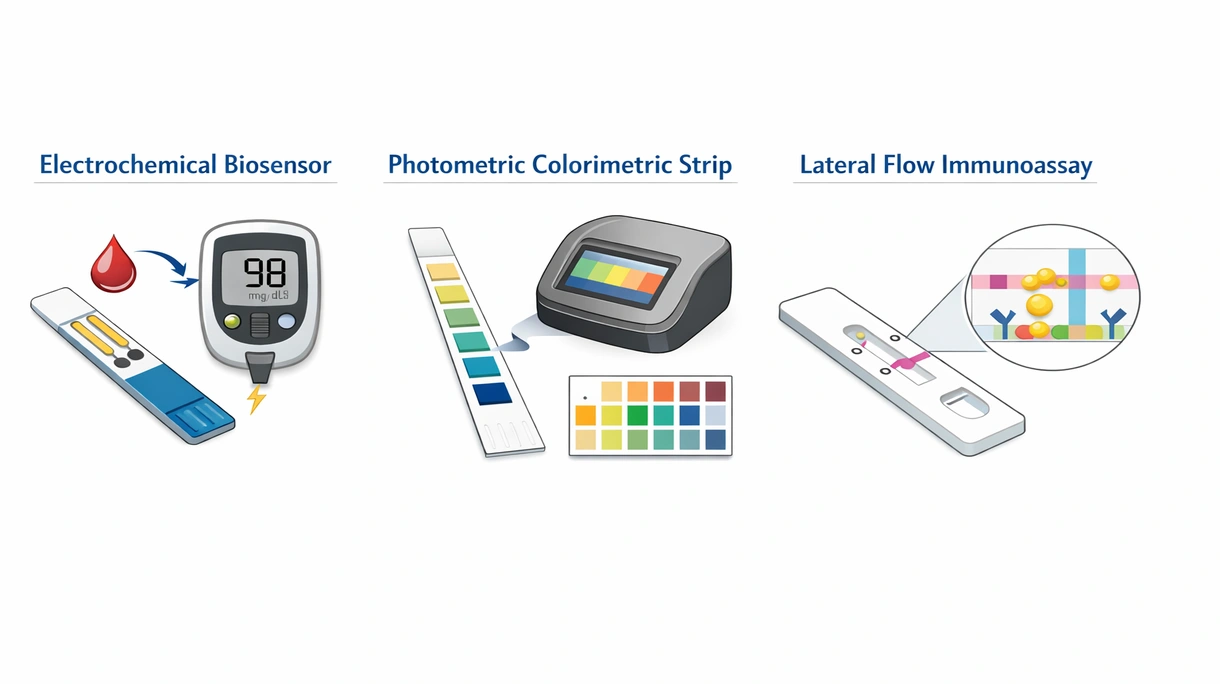
Electrochemical Biosensors
Electrodes generate current proportional to analyte concentration, providing rapid digital quantification. High accuracy benefits clinical settings, though higher costs necessitate careful budget trade-offs compared to simpler optical methods.
Photometric Colorimetric Strips
Reagents produce color changes measured by optical readers or compared against reference charts. Cost-effectiveness suits high-volume screening, yet operational trade-offs include vulnerability to light interference and visual interpretation errors.
Lateral Flow Immunoassays
Utilizing gold nanoparticles, these strips detect proteins through antibody-antigen binding on membrane layers. High specificity improves diagnostic reliability, but operational trade-offs involve qualitative rather than precise numerical concentration data.
6 expert tips
Prioritize strips with integrated hematocrit compensation to ensure accuracy across pediatric and geriatric patients with varying red cell volumes.
Implement closed-system procurement to maximize analyzer compatibility and reduce error rates associated with mismatched third-party diagnostic consumables.
Negotiate volume-based supply contracts that include automated replenishment to avoid clinical workflow disruptions caused by critical reagent stockouts.
Select strip packaging with moisture-resistant desiccant liners to preserve chemical stability and shelf life in high-humidity clinical settings.
Audit manufacturer data regarding cross-reactivity with common pharmacological treatments to prevent therapeutic interference and incorrect patient management decisions.
Always verify the technical certification to ensure compliance with local building safety standards and long-term durability.
Innovations and Trends
Single strips now detect multiple biomarkers simultaneously, significantly reducing sample collection time and improving diagnostic efficiency for clinicians.
Emerging strips feature NFC or QR coding to automate lot calibration and patient data integration into electronic records.
Novel reagent formulations extend thermal tolerance, reducing the need for cold-chain logistics in various environmental medical conditions.
Advanced strip architecture improves sample flow control, minimizing user error and enhancing precision for low-volume capillary blood.
*Prices are pre-tax. They exclude delivery charges and customs duties and do not include additional charges for installation or activation options. Prices are indicative only and may vary by country, with changes to the cost of raw materials and exchange rates.
About MedicalExpo
MedicalExpo is a marketplace that offers B2B players a complete experience, from product sourcing to purchase. MedicalExpo is an entity of VirtualExpo Group.
Are you a buyer?
Are you a supplier?