


{{product.productLabel}} {{product.model}}
{{#if product.featureValues}}{{product.productPrice.formattedPrice}} {{#if product.productPrice.priceType === "PRICE_RANGE" }} - {{product.productPrice.formattedPriceMax}} {{/if}}
{{#each product.specData:i}}
{{name}}: {{value}}
{{#i!=(product.specData.length-1)}}
{{/end}}
{{/each}}
{{{product.idpText}}}


Storage temperature: 15, 30 °C
... COL-APSE is a sensitive and specific medium for the growth of Colistin resistant bacterial pathogens with a lower limit of detection of 10 CFU/mL. This new chromogenic medium may be useful as a primary isolation medium ...
CHROMagar

Storage temperature: 15, 30 °C
... spreading or filtration technique) whereas with TSC medium bacteria have to be placed between two layers of agar in order to grow in black colonies. 2. Specific medium for Clostridium perfringens while TSC medium ...
CHROMagar

Storage temperature: 15, 30 °C
... accordance with ISO 22964 standard. 1. ISO 22964 Standard: CHROMagar™ Cronobacter is a chromogenic medium for detection of Cronobacter spp. in food, animal feed and environmental samples according to the ISO 22964 ...
CHROMagar

Storage temperature: 2, 30, 8 °C
Listeria monocytogenes is a widespread bacteria, present in the soil, sewage or faecal matter. Its ability to form listerial biofilms on contact surfaces makes it difficult to eliminate. This pathogen can cause serious food poisoning and is therefore ...
CHROMagar

Storage temperature: 15, 30 °C
... detected by a characteristic mauve colour after only 24 h of incubation, while most other E. coli are blue. The conventional medium for the detection of E. coli O157 is Sorbitol MacConkey (SMAC) Agar, which has very poor specificity, ...
CHROMagar
Storage temperature: 15, 30 °C
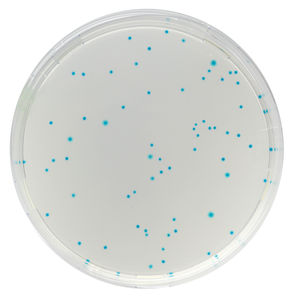
Contamination by faecal material from animals can be shown by the detection of Escherichia coli in the sample. E. coli can contaminate drinking water when the water treatment system is inadequate or during periods of very high rainfalls. Monitoring of ...
CHROMagar

Storage temperature: 15, 30 °C
... Pseudomonas are ubiquitous bacteria found in the soil, on plants, in freshwater and marine habitats. Many strains can grow at low temperature (psychrophilic strains) and may contaminate food or pharmaceutical products stored in the refrigerator. P. ...
CHROMagar

Storage temperature: 15, 30 °C
... colonie colours : thanks to its powerful chromogenic technology. Easy reading especially when compared to the conventional TCBS medium based on sucrose fermentation revealed with a pH indicator. ...
CHROMagar

Storage temperature: 8, 2, 30, 15 °C
... TTA) and lung). This chromogenic medium to aid in qualitative diagnosis allows the detection and isolation of Pasteurellaceae colonies by inhibition or differentiation of the annex flora. CHROMagar™ Pasteurella medium ...
CHROMagar

Storage temperature: 15, 30 °C
... Malassezia is a fungi naturally found on animal skins. On normal healthy skin it does not cause infections, but when the environment of the skin is altered, Malassezia species are able to cause several cutaneous diseases as severe dermatitis ...
CHROMagar


Storage temperature: 2 °C - 8 °C
... chromogenic differentiation Storage Medium can be kept for one day at ambient temperature. Avoid freezing or prolonged storage at temperatures above 40°C. Do not open until ready to use. Do not use if the medium ...

Storage temperature: 15 °C - 25 °C
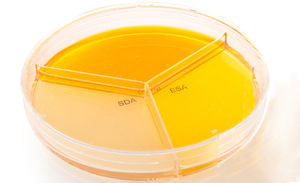
... MYKODERMOASSAY TRIO is a culture medium (DTM/ESA/SAB) for the qualitative detection of veterinary relevant dermatophytes in pocket pets, pets and farm animals. Dermatophytoses/ringworm belong to the ...