


- Products
- Catalogs
- News & Trends
- Exhibitions
Non-invasive cardiac output monitor EdgeFlow CW10


Add to favorites
Compare this product
Characteristics
- Type of monitoring
- non-invasive
Description
Overview
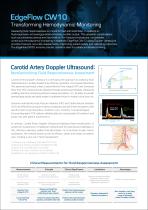
The EdgeFlow CW10 is a non-invasive, continuous hemodynamic monitoring system using carotid Doppler ultrasound to assess fluid responsiveness in real time. It delivers continuous VTI and FTc measurements to support fluid management, enhance patient safety, and optimize treatment decisions in critical care and perioperative settings. Clinical evidence supports its use in critically ill patients.[1][2][3][4][5]
Carotid Artery Doppler Ultrasound
Carotid artery pulsed wave Doppler with the EdgeFlow CW10 uses the Carotid Velocity Time Integral (VTI) and Corrected Flow Time (FTc) to estimate changes in stroke volume and cardiac output. This non-invasive approach provides a rapid alternative to invasive monitoring for assessing fluid responsiveness at the bedside.
Clinical Measurements for Fluid Responsiveness Assessment
Patch-Type Ultrasound Probes
The CW10 uses a patch-type Doppler probe that adheres to the skin for continuous, hands-free monitoring. This design reduces the need for prolonged manual probe handling or invasive alternatives (e.g., TEE), enabling comfortable continuous monitoring across diverse clinical scenarios.
Overcoming Doppler Challenges
The system integrates AngleFree™ technology to reduce or remove manual angle adjustment, improving measurement reliability and simplifying operation for users at all experience levels. TraqVue™ provides B-mode imaging for real-time guidance and confirmation of probe positioning.
Display, Usability and Data
Clinical Benefits
Technical specifications
The EdgeFlow CW10 is a non-invasive, continuous hemodynamic monitoring system using carotid Doppler ultrasound to assess fluid responsiveness in real time. It delivers continuous VTI and FTc measurements to support fluid management, enhance patient safety, and optimize treatment decisions in critical care and perioperative settings. Clinical evidence supports its use in critically ill patients.[1][2][3][4][5]
Carotid Artery Doppler Ultrasound
Carotid artery pulsed wave Doppler with the EdgeFlow CW10 uses the Carotid Velocity Time Integral (VTI) and Corrected Flow Time (FTc) to estimate changes in stroke volume and cardiac output. This non-invasive approach provides a rapid alternative to invasive monitoring for assessing fluid responsiveness at the bedside.
Clinical Measurements for Fluid Responsiveness Assessment
- Stroke Volume Variation (SVV): Variation in stroke volume during respiration. Clinical significance: predicts fluid responsiveness. Limitations: requires controlled ventilation, may need invasive arterial pressure monitoring, affected by arrhythmias. Advantages: widely used and validated.
- Pulse Pressure Variation (PPV): Variation in pulse pressure during respiration. Clinical significance: predicts fluid responsiveness. Limitations and advantages: same considerations as SVV.
- Velocity Time Integral (VTI): Measures blood flow velocity over time, reflecting stroke volume. Clinical significance: predicts fluid responsiveness and estimates cardiac output. Limitations: operator-dependent, limited by patient anatomy. Advantages: non-invasive, continuous, applicable to a broader patient population and easy to apply.
- Corrected Flow Time (FTc): Measures systolic blood flow duration corrected for heart rate. Clinical significance: assesses fluid responsiveness and cardiac function. Limitations and advantages: similar to VTI.
Patch-Type Ultrasound Probes
The CW10 uses a patch-type Doppler probe that adheres to the skin for continuous, hands-free monitoring. This design reduces the need for prolonged manual probe handling or invasive alternatives (e.g., TEE), enabling comfortable continuous monitoring across diverse clinical scenarios.
Overcoming Doppler Challenges
The system integrates AngleFree™ technology to reduce or remove manual angle adjustment, improving measurement reliability and simplifying operation for users at all experience levels. TraqVue™ provides B-mode imaging for real-time guidance and confirmation of probe positioning.
Display, Usability and Data
- 12.1-inch color IPS touchscreen with 1024×768 resolution for clear visualization of measurements.
- Intuitive user interface optimized for efficient clinical workflow.
- Sleek, lightweight design suitable for ICU and operating room environments.
- Probe rating IPX4 and flexible mounting options for use near fluids or contaminants.
- On-device storage of measurements with exportable CSV files to support clinical research and data analysis.
Clinical Benefits
- Continuous, non-invasive monitoring of fluid responsiveness at the bedside.
- Real-time VTI and FTc metrics to support rapid decision-making.
- Hands-free patch probe enhances patient comfort and reduces staff workload.
- AngleFree™ and TraqVue™ increase measurement robustness and ease of use.
Technical specifications
- Model: EdgeFlow CW10
- Technology: Carotid Doppler ultrasound (pulsed wave Doppler)
- Key measurements: Velocity Time Integral (VTI), Corrected Flow Time (FTc), supports SVV/PPV context
- Probe type: Patch-type continuous Doppler probe (hands-free)
- Probe rating: IPX4
- Display: 12.1-inch color IPS touchscreen
- Display resolution: 1024 x 768 pixels
- Special features: AngleFree™ automatic Doppler angle compensation; TraqVue™ B-mode imaging guidance
- Data export: Measurements stored on device; exportable as CSV
- Video: Onboard or associated media for training and demonstration
VIDEO
Catalogs
EdgeFlow CW10
2 Pages
Exhibitions
Meet this supplier at the following exhibition(s):

MEDICA 2026
16-19 Nov 2026 Düsseldorf (Germany) Hall 11 - Stand A27
Related Searches
*Prices are pre-tax. They exclude delivery charges and customs duties and do not include additional charges for installation or activation options. Prices are indicative only and may vary by country, with changes to the cost of raw materials and exchange rates.