



- Rehabilitation
- Kinesitherapy, Physiotherapy
- Hip isokinetic dynamometer
- Guangzhou Yeecon Medical Equipment Industrial
Shoulder isokinetic dynamometer A8-2anklehipknee


Add to favorites
Compare this product
Characteristics
- Area of the body
- shoulder, ankle, hip, knee, elbow, wrist
Description
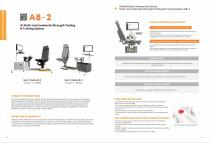
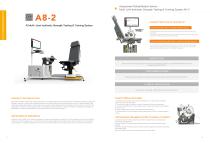
Comprehensive multi-joint system for evaluation and training of isokinetic, isometric, isotonic and continuous passive programs across shoulder, elbow, wrist, hip, knee and ankle.
Product introduction
The AI A8-2 provides clinical-grade assessment and progressive training protocols for six major joints. Test and training sessions generate numerical data and graphs that can be reviewed, exported and printed as clinical or research reports. Multiple modes support rehabilitation from early passive motion to advanced strength conditioning.
Definition of isokinetic
Isokinetic motion: movement at a preset constant angular velocity with variable resistance. The device maintains the set speed while resistance varies with user force, enabling torque measurement without acceleration.
Key characteristics
Indications
Contraindications
Clinical applications
Orthopedic rehabilitation pathway
Technical specifications
Product introduction
The AI A8-2 provides clinical-grade assessment and progressive training protocols for six major joints. Test and training sessions generate numerical data and graphs that can be reviewed, exported and printed as clinical or research reports. Multiple modes support rehabilitation from early passive motion to advanced strength conditioning.
Definition of isokinetic
Isokinetic motion: movement at a preset constant angular velocity with variable resistance. The device maintains the set speed while resistance varies with user force, enabling torque measurement without acceleration.
Key characteristics
- Accurate strength testing: measures peak torque and torque across joint angles to assess bilateral differences and agonist/antagonist ratios.
- Safe, adaptive training: applies controlled resistance at each joint angle and reduces load if subject strength decreases.
- Data management: records, analyzes and compares successive tests; supports report generation and printing.
- Dual range-of-motion protection: mechanical and software limits to ensure safe testing/training boundaries.
Indications
- Motor dysfunction from sports injuries, post‑operative orthopedics, conservative treatments, nerve lesions and similar causes.
Contraindications
- High fracture risk, acute disease phase, severe pain or marked joint mobility restriction.
Clinical applications
- Orthopedics, neurology, rehabilitation, sports medicine and functional research.
Orthopedic rehabilitation pathway
- Continuous passive motion: maintain/restore ROM and reduce contractures/adhesions.
- Isometric training: counteract disuse and initiate strength recovery.
- Isokinetic training: increase muscle strength and optimize fiber recruitment.
- Isotonic training: improve neuromuscular control.
Technical specifications
- Model: A8-2
- Supported joints: shoulder, elbow, wrist, hip, knee, ankle
- Operating modes: isokinetic, isometric, isotonic, continuous passive
- Predefined movement modes: 22
- Measured parameters: peak torque, peak torque/bodyweight ratio, work, etc.
- Outputs: on‑screen visualization, data export and printable reports (data & graphs)
- Safety: dual ROM protection; adaptive resistance control
VIDEO
Catalogs
Exhibitions
Meet this supplier at the following exhibition(s):

MEDICA 2026
16-19 Nov 2026 Düsseldorf (Germany) Hall 4 - Stand J18
Other Guangzhou Yeecon Medical Equipment Industrial products
Assessment


Related Searches
- Yeecon electric stimulator
- TENS physiotherapy
- Yeecon rehabilitation system
- EMS physiotherapy
- Yeecon ESWT unit
- Pressure therapy unit
- Yeecon orthopedic treatment ESWT unit
- Yeecon computer-assisted rehabilitation system
- Yeecon robotic rehabilitation system
- Ultrasound stimulator physiotherapy
- Magnetic therapy unit kinesitherapy
- Continuous passive motion device
- Table-top ESWT unit
- Bobath table
- Electric massager
- Leg pressure therapy unit
- Yeecon rehabilitation system with serious games
- Yeecon gait rehabilitation system
- Yeecon hand mobility rehabilitation system
- Yeecon rehabilitation system with interactive workout
*Prices are pre-tax. They exclude delivery charges and customs duties and do not include additional charges for installation or activation options. Prices are indicative only and may vary by country, with changes to the cost of raw materials and exchange rates.
About MedicalExpo
MedicalExpo is a marketplace that offers B2B players a complete experience, from product sourcing to purchase. MedicalExpo is an entity of VirtualExpo Group.
Are you a buyer?
Are you a supplier?