


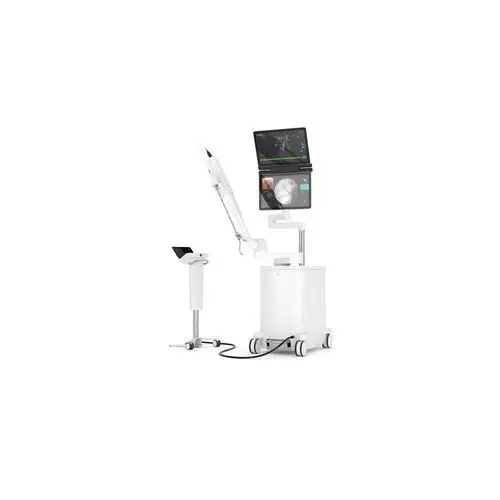
- Surgery unit
- Operating room
- Biopsy surgical robot
- Intuitive Surgical
Bronchoscopy surgical robot Ionbiopsyexploration

Add to favorites
Compare this product
Characteristics
- Application
- bronchoscopy
- Type
- biopsy, exploration
Description
Overview
Ion endoluminal system is a robotic bronchoscopy platform for minimally invasive peripheral lung biopsy. Designed to help clinicians reach and sample small, difficult-to-access peripheral pulmonary nodules across all 18 lung segments, the system pairs an ultrathin, highly maneuverable catheter with continuous shape-sensing navigation to improve reach, precision and stability compared with manual bronchoscopy techniques.
Key features
Clinical impact
Ion aims to shorten the diagnostic pathway by enabling earlier biopsy of small peripheral nodules that are otherwise difficult to reach. This can reduce delays from repeated imaging or multiple biopsy attempts and support thoracic oncology programs. The platform literature notes more than 100,000 Ion biopsies performed, reflecting clinical adoption and procedural experience.
Videos and educational materials
Product resources include procedure and case videos, system overviews and patient-perspective materials covering system design, shape-sensing technology and clinical workflows to support training and program development.
Safety and intended use
Risks associated with bronchoscopy and anesthesia may include sore throat, hoarseness, respiratory complications (dyspnea, hypoxemia), airway injury, bronchospasm, laryngospasm, fever, hemoptysis, chest or lung infection including pneumonia, lung abscess, bleeding, pneumothorax, cardiac complications, respiratory failure, air embolism or death. Procedures with the Ion endoluminal system may be associated with longer procedure and/or anesthesia time.
The Ion endoluminal system assists the user in navigating a catheter and endoscopic tools in the pulmonary tract using endoscopic visualization of the tracheobronchial tree for diagnostic and therapeutic procedures and enables fiducial marker placement. It does not provide a diagnosis and is not intended for pediatric use. Information from the system is guidance and not a substitute for clinical decision-making by a trained physician.
Notes on evidence and testing
Performance claims (reach, precision, stability, PlanPoint functions and imaging integration) are based on internal testing and data on file since the system introduction in 2019. Preclinical models and integration testing (e.g., tool-in-lesion accuracy) are referenced in product materials.
Technical specifications
Ion endoluminal system is a robotic bronchoscopy platform for minimally invasive peripheral lung biopsy. Designed to help clinicians reach and sample small, difficult-to-access peripheral pulmonary nodules across all 18 lung segments, the system pairs an ultrathin, highly maneuverable catheter with continuous shape-sensing navigation to improve reach, precision and stability compared with manual bronchoscopy techniques.
Key features
- Ultrathin, ultramaneuverable catheter enabling access to small peripheral nodules in all 18 pulmonary segments.
- Fiber-optic shape-sensing technology that measures catheter shape hundreds of times per second to provide continuous location, shape and orientation during navigation and biopsy.
- Compatibility with intraprocedural cone-beam CT (CBCT) for refined navigation and tool-in-lesion verification.
- PlanPoint planning software: generates 3D airway trees from patient CT, segments nodules automatically and creates navigation paths to targets.
- Open-access platform supporting integration of compatible tools and workflows.
- Flexision Biopsy Needle designed for tissue sampling with the Ion system.
- Data and case-management via My Intuitive for combined system and clinical insights.
Clinical impact
Ion aims to shorten the diagnostic pathway by enabling earlier biopsy of small peripheral nodules that are otherwise difficult to reach. This can reduce delays from repeated imaging or multiple biopsy attempts and support thoracic oncology programs. The platform literature notes more than 100,000 Ion biopsies performed, reflecting clinical adoption and procedural experience.
Videos and educational materials
Product resources include procedure and case videos, system overviews and patient-perspective materials covering system design, shape-sensing technology and clinical workflows to support training and program development.
Safety and intended use
Risks associated with bronchoscopy and anesthesia may include sore throat, hoarseness, respiratory complications (dyspnea, hypoxemia), airway injury, bronchospasm, laryngospasm, fever, hemoptysis, chest or lung infection including pneumonia, lung abscess, bleeding, pneumothorax, cardiac complications, respiratory failure, air embolism or death. Procedures with the Ion endoluminal system may be associated with longer procedure and/or anesthesia time.
The Ion endoluminal system assists the user in navigating a catheter and endoscopic tools in the pulmonary tract using endoscopic visualization of the tracheobronchial tree for diagnostic and therapeutic procedures and enables fiducial marker placement. It does not provide a diagnosis and is not intended for pediatric use. Information from the system is guidance and not a substitute for clinical decision-making by a trained physician.
Notes on evidence and testing
Performance claims (reach, precision, stability, PlanPoint functions and imaging integration) are based on internal testing and data on file since the system introduction in 2019. Preclinical models and integration testing (e.g., tool-in-lesion accuracy) are referenced in product materials.
Technical specifications
- Product name: Ion endoluminal system
- Model designation: IF1000
- Primary function: Robotic-assisted bronchoscopy platform for navigation and biopsy in the pulmonary tract
- Catheter: Ultrathin, ultramaneuverable catheter designed for peripheral lung access (reach to all 18 lung segments)
- Navigation technology: Fiber-optic shape-sensing providing continuous shape and position sensing (hundreds of shape measurements per second)
- Imaging integration: Compatible with cone-beam CT (CBCT) workflows for intraprocedural imaging and tool-in-lesion verification
- Planning software: PlanPoint — generates 3D airway trees from CT, auto-segments nodules and generates navigation paths
- Biopsy instrument compatibility: Flexision Biopsy Needle (used with Ion for tissue sampling)
- Data platform: My Intuitive integration for combined system and clinical case data and practice insights
- Intended patient population: Adult diagnostic and therapeutic pulmonary procedures (not for pediatric use)
- Regulatory / privacy controls: Product literature references third-party privacy and security certifications (e.g., HITRUST, NIST frameworks) for data handling
Catalogs
No catalogs are available for this product.
See all of Intuitive Surgical‘s catalogsOther Intuitive Surgical products
Products




Related Searches
- Endoscopic camera
- High-definition camera
- Surgical camera
- Fluorescence camera
- Robotic-assisted surgery system
- Near-infrared camera
- Guiding surgical robot
- Laparoscopic surgery robot
- Camera holding surgical robot
- Instrument holding surgical robot
- Gynecological surgery robot
- Urological surgery robot
- Needle positioning surgical robot
- Thoracic surgery robot
- Colorectal surgery robot
- Cutting surgical robot
- Biopsy surgical robot
- ENT surgery robot
*Prices are pre-tax. They exclude delivery charges and customs duties and do not include additional charges for installation or activation options. Prices are indicative only and may vary by country, with changes to the cost of raw materials and exchange rates.
About MedicalExpo
MedicalExpo is a marketplace that offers B2B players a complete experience, from product sourcing to purchase. MedicalExpo is an entity of VirtualExpo Group.
Are you a buyer?
Are you a supplier?