


Gait rehabilitation system ReStore Exo-Suitposturerobotic

Add to favorites
Compare this product
Characteristics
- Therapy type
- gait, posture
- Technology
- robotic
Description
Overview
The ReStore exo-suit is a soft, textile-based robotic device designed to assist restoration of functional walking patterns after stroke. Intended for clinical rehabilitation use, it provides coordinated mechanical assistance to the paretic ankle during push-off and swing phases to support physiologically relevant gait training.
Key benefits
How it works
ReStore delivers coordinated support for ankle plantarflexion and dorsiflexion via motors mounted on a waist belt. Power is transmitted through cables to a calf cuff and to an insole interface placed inside the patients shoe. Shoe-mounted sensors analyze movement and time assistance using gait algorithms. A trained therapist uses a handheld controller to monitor parameters, set assistance levels, select modes, and record standardized gait assessments.
Clinical benefits (summary table)
Table headers: Study | Walking Speed | Walking Distance | Propulsion Symmetry | Reduced Compensations | Stride Length | Metabolic Effort | Ground Clearance | Paretic Ankle Power | Muscle Activation | Device Safety | User Satisfaction
Awad et al., Journal of NeuroEngineering and Rehabilitation (2020) | Improvements reported: Walking Speed; Device Safety; User Satisfaction.
Awad et al., Journal of NeuroEngineering and Rehabilitation (2020) (additional outcomes reported) | Improvements reported: Walking Speed; Walking Distance; Propulsion Symmetry; Reduced Compensations; Stride Length; Ground Clearance; User Satisfaction.
Awad et al., IEEE Open Journal of Engineering in Medicine and Biology (2020) | Improvements reported: Walking Speed; Walking Distance.
Porcuincula et al., American Society of Neurorehabilitation Conference (2019) | Improvements reported across multiple gait outcomes and metabolic effort in case reports.
Sloot et al., Gait & Posture (2018) | Improvements in paretic ankle power, muscle activation measures and related gait outcomes.
Awad et al., Science Translational Medicine (2017) | Reductions in compensatory strategies and improvements in paretic ankle power and ground clearance.
Awad et al., American Journal of Physical Medicine & Rehabilitation (2017) | Improvements in stride length and related gait mechanics.
Product resources & media
Available resources include clinical study summaries, educational videos, clinician and patient information packets, and clinical testimonials demonstrating use in rehabilitation settings.
Indications for use
The ReStore is intended to assist ambulatory function in rehabilitation institutions under supervision of a trained therapist for individuals with hemiplegia or hemiparesis due to stroke who can ambulate at least 1.5 m with no more than minimal to moderate assistance. Therapists must complete training prior to operating the device. Not intended for sports activities or stair climbing.
Features
Characteristics / technical specifications
The ReStore exo-suit is a soft, textile-based robotic device designed to assist restoration of functional walking patterns after stroke. Intended for clinical rehabilitation use, it provides coordinated mechanical assistance to the paretic ankle during push-off and swing phases to support physiologically relevant gait training.
Key benefits
- Documented therapeutic outcomes in multiple clinical studies, including improvements in walking speed, distance, propulsion symmetry, and training intensity.
- FDA-cleared and CE-cleared device that provides assistance to both ankle plantarflexion and dorsiflexion during gait.
- Soft, untethered, textile-based design allows overground walking and integration with varied therapeutic activities and environments.
- Sensor-driven algorithms and adjustable assistance parameters support individualized, higher-intensity gait training under therapist supervision.
How it works
ReStore delivers coordinated support for ankle plantarflexion and dorsiflexion via motors mounted on a waist belt. Power is transmitted through cables to a calf cuff and to an insole interface placed inside the patients shoe. Shoe-mounted sensors analyze movement and time assistance using gait algorithms. A trained therapist uses a handheld controller to monitor parameters, set assistance levels, select modes, and record standardized gait assessments.
Clinical benefits (summary table)
Table headers: Study | Walking Speed | Walking Distance | Propulsion Symmetry | Reduced Compensations | Stride Length | Metabolic Effort | Ground Clearance | Paretic Ankle Power | Muscle Activation | Device Safety | User Satisfaction
Awad et al., Journal of NeuroEngineering and Rehabilitation (2020) | Improvements reported: Walking Speed; Device Safety; User Satisfaction.
Awad et al., Journal of NeuroEngineering and Rehabilitation (2020) (additional outcomes reported) | Improvements reported: Walking Speed; Walking Distance; Propulsion Symmetry; Reduced Compensations; Stride Length; Ground Clearance; User Satisfaction.
Awad et al., IEEE Open Journal of Engineering in Medicine and Biology (2020) | Improvements reported: Walking Speed; Walking Distance.
Porcuincula et al., American Society of Neurorehabilitation Conference (2019) | Improvements reported across multiple gait outcomes and metabolic effort in case reports.
Sloot et al., Gait & Posture (2018) | Improvements in paretic ankle power, muscle activation measures and related gait outcomes.
Awad et al., Science Translational Medicine (2017) | Reductions in compensatory strategies and improvements in paretic ankle power and ground clearance.
Awad et al., American Journal of Physical Medicine & Rehabilitation (2017) | Improvements in stride length and related gait mechanics.
Product resources & media
Available resources include clinical study summaries, educational videos, clinician and patient information packets, and clinical testimonials demonstrating use in rehabilitation settings.
Indications for use
The ReStore is intended to assist ambulatory function in rehabilitation institutions under supervision of a trained therapist for individuals with hemiplegia or hemiparesis due to stroke who can ambulate at least 1.5 m with no more than minimal to moderate assistance. Therapists must complete training prior to operating the device. Not intended for sports activities or stair climbing.
Features
- Assists ankle plantarflexion (push-off/propulsion) and dorsiflexion (swing/ground clearance).
- Motors mounted on a waist belt transmit force via cables to a calf cuff and insole interface.
- Shoe/insole sensors and sensor-driven gait algorithms time assistance to user movement.
- Handheld controller for therapist monitoring, assistance adjustment, mode selection, and recording of gait assessments.
- Soft, textile-based, lightweight, untethered design compatible with overground walking and varied therapy activities.
- Designed specifically for post-stroke hemiparetic gait rehabilitation to promote more physiologically normal, symmetrical walking patterns.
Characteristics / technical specifications
- Device type: Soft robotic exo-suit (textile-based, untethered).
- Assistance: Coordinated plantarflexion and dorsiflexion of the paretic ankle (push-off and swing phases).
- Actuation: Motors on a waist belt transmitting force via cables to a calf cuff and insole interface.
- Sensing and control: Shoe/insole sensors and gait algorithms for timing; therapist-configurable assistance parameters via handheld controller.
- Regulatory: FDA-cleared and CE-cleared for clinical rehabilitation use.
- Intended users: Individuals with hemiplegia/hemiparesis due to stroke, ambulatory at least 1.5 m with minimal to moderate assistance; operation under trained therapist supervision only.
- Limitations: Not intended for sports activities or stair climbing.
Catalogs
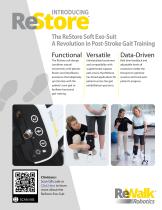
ReStore-Exo-Suit_Info
8 Pages
Other Lifeward GmbH products
Products


*Prices are pre-tax. They exclude delivery charges and customs duties and do not include additional charges for installation or activation options. Prices are indicative only and may vary by country, with changes to the cost of raw materials and exchange rates.
About MedicalExpo
MedicalExpo is a marketplace that offers B2B players a complete experience, from product sourcing to purchase. MedicalExpo is an entity of VirtualExpo Group.
Are you a buyer?
Are you a supplier?