



- Company
- Products
- Catalogs
- News & Trends
- Exhibitions
SaaS software hospitalemergencynursing care


Add to favorites
Compare this product
Characteristics
- Applications
- hospital, emergency, nursing care, for healthcare facilities, for patient rooms, retirement home
- Function
- analysis, monitoring, recording
- Type
- AI
- Deployment mode
- SaaS
Description
Overview
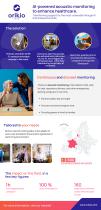
Orikio is an acoustic monitoring device for nursing homes that delivers continuous, privacy-preserving detection of critical events using on‑device acoustic AI. The system analyzes ambient sound in real time without continuous recording and issues targeted alerts to caregivers for faster, informed responses.
Key benefits / Why Orikio?
How it works
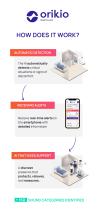
Orikio is a plug-and-play box installed in each room that continuously analyzes relevant sounds and notifies the care team when an event is detected.
Detection scope (examples)
Privacy & data handling
Audio is analyzed in real time and not recorded continuously. Only short snippets linked to detected alerts may be temporarily captured to enable remote evaluation; these snippets are not stored long‑term. The device can enter standby when a third person is present and no cameras are used, minimizing intrusion.
Deployment & hardware
The solution consists of a small, plug-and-play box per room that connects to Wi‑Fi and transmits alerts and anonymized monitoring data to caregiver apps and reporting tools.
Use cases
Frequently asked points
Technical specifications
Orikio is an acoustic monitoring device for nursing homes that delivers continuous, privacy-preserving detection of critical events using on‑device acoustic AI. The system analyzes ambient sound in real time without continuous recording and issues targeted alerts to caregivers for faster, informed responses.
Key benefits / Why Orikio?
- Automatic detection of risk events (falls, calls for help, respiratory distress, vomiting, agitation) to speed up intervention.
- Operational efficiency: reduces unnecessary rounds and enables staff to focus on priority care tasks.
- Personalized monitoring: the system adapts to residents' routines to reduce false positives and improve relevance.
- Privacy-first design: sound‑only analysis with no camera and no continuous audio storage.
- Immediate notifications: descriptive alerts sent to caregivers' smartphones for remote triage and action.
How it works
Orikio is a plug-and-play box installed in each room that continuously analyzes relevant sounds and notifies the care team when an event is detected.
- Quick installation: connect the device to power and local Wi‑Fi—no wiring or complex setup required.
- On-device acoustic AI: real-time sound analysis runs locally to identify critical audio signatures while preserving privacy.
- Alert flow: when an event is detected, caregivers receive descriptive alerts and can listen to a few seconds of audio tied to the alert for assessment.
- Human support: deployment assistance, training and operational support are provided to ensure proper use and interpretation.
Detection scope (examples)
- Falls
- Calls for help / vocal distress
- Respiratory distress / abnormal breathing sounds
- Vomiting
- Agitation or agitation‑related sounds
Privacy & data handling
Audio is analyzed in real time and not recorded continuously. Only short snippets linked to detected alerts may be temporarily captured to enable remote evaluation; these snippets are not stored long‑term. The device can enter standby when a third person is present and no cameras are used, minimizing intrusion.
Deployment & hardware
The solution consists of a small, plug-and-play box per room that connects to Wi‑Fi and transmits alerts and anonymized monitoring data to caregiver apps and reporting tools.
Use cases
- Immediate alerting for acute events (falls, severe distress)
- Ongoing behavioral monitoring and early detection of health deterioration
- Reducing staff workload and improving allocation of care time
- Improving family reassurance through enhanced resident safety
Frequently asked points
- Are sounds recorded? — No continuous recording. Only brief audio segments associated with detected alerts may be captured temporarily for evaluation.
- Does the solution protect residents' privacy? — Yes. Processing is sound-only, the device can auto‑standby when others are present, and long‑term audio storage is avoided.
- How does the system adapt to each resident? — A dedicated device per room allows the AI to learn individual routines and personalize detection settings.
Technical specifications
- Technology: on-device acoustic artificial intelligence (sound-only, no camera)
- Installation: plug-in device; automatic Wi‑Fi connection; no wiring required
- Operational mode: continuous ambient sound analysis with real-time alert generation
- Data capture: only short audio snippets related to detected alerts may be temporarily captured; no continuous storage
- Privacy features: automatic standby when a third person enters the room; designed to respect sleep and privacy
- Alert delivery: instant notifications to caregivers' smartphones; remote evaluation possible
- Reporting: monitoring reports highlighting habit changes and early warning signs
- Support: deployment assistance, training and operational support included
VIDEO
Catalogs
Infographic Orikio
1 Pages
Brochure Orikio
1 Pages
Other Orikio products
Our solutions


Related Searches
- Analysis software
- Monitoring software
- Online software
- Hospital software
- AI software
- Recording software
- Home medical alert system
- Emergency department software
- Fall alert system
- GPS tracking alert system
- Nursing care software
- Healthcare facility software
- SaaS software
- Wall alert system
- Nursing home alert system
- Patient room software
*Prices are pre-tax. They exclude delivery charges and customs duties and do not include additional charges for installation or activation options. Prices are indicative only and may vary by country, with changes to the cost of raw materials and exchange rates.
About MedicalExpo
MedicalExpo is a marketplace that offers B2B players a complete experience, from product sourcing to purchase. MedicalExpo is an entity of VirtualExpo Group.
Are you a buyer?
Are you a supplier?