

- Medical Technical Facilities
- Medical training
- Training simulator
- Simulation of Aging and Disability


- Company
- Products
- Catalogs
- News & Trends
- Exhibitions
Aging simulator for demonstration

Add to favorites
Compare this product
Characteristics
- Procedure
- for demonstration
- Simulated pathology / condition
- aging
Description
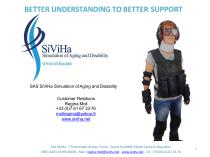
We offer you to feel and understand the effects of aging thanks to our aging simulation suit with the aim of improving the environment and living conditions of the elderlys. Our aging simulation kit is adaptable to all sizes and morphologies.
THE AGING PROCESS
Understanding the aging process by simulation
The lens of the eye begins to age from the age of 11.
The different physiological systems (vascular, cardiac, cerebral, neurosensory and bone) gets old from 18-20 years :
Respiratory function is greatly reduced with age
High blood pressure increases with age and arteriosclerosis appears
Bone aging, osteoporosis and osteomalacia
Joint aging characterized by osteoarthritis
Muscle aging ( decrease in muscle strength ). Difficulty in repeating effort, decrease in strength, endurance, resistance, speed, flexibility and coordination of movements. Sarcopenia is a progressive loss of muscle mass associated with aging. Its prevalence is high, between 10% and 24% of the population aged 65 to 70 years and up to more than 30% after 80 years.
Functionally, it is important to consider the loss of muscle power as it is involved in many basic activities important such as sit-stand transfer, climbing stairs or simply walking. In an imbalance, muscle distrust is often an aggravating factor for falls with medical consequences.
Decreased perceptual abilities, including impaired hearing and vision, disturb the balance of the body and cause instability of posture.
Some of the elements used in the simulation of different disabilities can also be used in the simulation of ageing.
Catalogs

Other Simulation of Aging and Disability products
Simulation of aging


*Prices are pre-tax. They exclude delivery charges and customs duties and do not include additional charges for installation or activation options. Prices are indicative only and may vary by country, with changes to the cost of raw materials and exchange rates.
About MedicalExpo
MedicalExpo is a marketplace that offers B2B players a complete experience, from product sourcing to purchase. MedicalExpo is an entity of VirtualExpo Group.
Are you a buyer?
Are you a supplier?