

- Medical Imaging
- Radiation protection, Dosimetry
- CT scan test phantom
- True Phantom Solutions


- Company
- Products
- Catalogs
- News & Trends
- Exhibitions
Ultrasound imaging test phantom FB-P01for MRIfor tomographyfor radiography

Add to favorites
Compare this product
Characteristics
- Type of calibration
- for ultrasound imaging, for MRI, for tomography, for radiography, for CT scan
- Area of the body
- thorax, pelvis, elbow, bladder, arm, foot, lung, femur, knee, kidney, whole body, brain, liver, spine, heart, hand, head, torso, leg, skull
- Patient type
- pediatric
Description
Overview
The pediatric full-body anthropomorphic phantom is an X‑Ray/CT and MRI‑compatible training and evaluation tool for clinical staff and imaging technicians. Based on a 4‑year‑old child model (40" / 102 cm), the life‑size phantom provides anatomically realistic organs and bones divided into 10 modular body parts for positioning practice and image quality assessment.
Key MRI and imaging properties
Tissue materials exhibit realistic T2 relaxation values suitable for T2‑weighted MRI protocols; proton‑density imaging also yields very good results. T1‑weighted contrast is achievable though T1 values are approximately ~100 ms and less realistic. Skeletal structures are individually cast from a patented epoxy‑based, ceramic‑reinforced composite.
Design & physical description
Life‑size pediatric full‑body phantom modeled on a 4‑year‑old child. Height: 40" (102 cm). Approximate weight: 20 kg. Anatomy is segmented into 10 detachable parts. Default finish: translucent amber; skin‑colored finish available on request. Minor appearance variations may occur due to material properties and manufacturing tolerances.
Anatomy — standard included features
Pediatric human torso (included organs & structures)
Torso organs (standard)
Pediatric human arms
Pediatric human legs
Included with order
Materials
Technical data — tissue properties (summary)
Thermal properties of bone‑mimicking material
Thermal conductivity: 0.776 W/mK; Volumetric specific heat capacity: 1.040 MJ/m3K; Thermal diffusivity: 0.746 mm2/s; Thermal resistivity: 1.289 mK/W; Specific heat: 0.978 J/g°C; Speed of sound: 3070 m/s
HU values of the tissue‑mimicking materials (average)
Body tissue: −25; Brain tissue: 800; Trabecular bone: 800; Cortical bone: 1300; Aorta: 40; Vena cava: 40; Trachea: 80 (tissue), −1000 (air); Lungs: −850; Diaphragm: 80; Pancreas: 110; Spleen: 110; Kidneys: 110; Bladder: 35; Rectum wall: 100; Sigmoid colon wall: 100; Heart: 40; Liver: 110; Gallbladder: 35; Stomach: −850; Large and small intestines: 80 (tissue), −1000 (air)
Notes
Standard phantoms are coated with a protective urethane rubber layer to improve appearance and scratch resistance; the coating increases apparent hardness (~+30 Shore OO vs. uncoated). Small variations in appearance may occur due to material characteristics and production tolerances.
The pediatric full-body anthropomorphic phantom is an X‑Ray/CT and MRI‑compatible training and evaluation tool for clinical staff and imaging technicians. Based on a 4‑year‑old child model (40" / 102 cm), the life‑size phantom provides anatomically realistic organs and bones divided into 10 modular body parts for positioning practice and image quality assessment.
Key MRI and imaging properties
Tissue materials exhibit realistic T2 relaxation values suitable for T2‑weighted MRI protocols; proton‑density imaging also yields very good results. T1‑weighted contrast is achievable though T1 values are approximately ~100 ms and less realistic. Skeletal structures are individually cast from a patented epoxy‑based, ceramic‑reinforced composite.
Design & physical description
Life‑size pediatric full‑body phantom modeled on a 4‑year‑old child. Height: 40" (102 cm). Approximate weight: 20 kg. Anatomy is segmented into 10 detachable parts. Default finish: translucent amber; skin‑colored finish available on request. Minor appearance variations may occur due to material properties and manufacturing tolerances.
Anatomy — standard included features
- Pediatric full body, life size
- Anatomically realistic body tissues and organs
- Shoulders: 360° rotation and 180° lateral movement
- Articulated hip joints, knees and elbows
- Detachable head, torso and limbs for modular assembly
- Optional pathological inserts (lesions, tumors, infections)
- Transparent or skin‑colored appearance options
- Pediatric human head with skull
Pediatric human torso (included organs & structures)
- Spine
- Ribcage
- Shoulders
- Clavicles
- Pelvis
Torso organs (standard)
- Trachea
- Heart
- Lungs
- Diaphragm
- Liver (including ligaments & bile ducts)
- Gallbladder
- Stomach
- Kidneys
- Spleen
- Pancreas
- Large and small intestines
- Bladder
- Prostate
Pediatric human arms
- Humerus
- Elbow joints
- Radius
- Ulna
- Wrist
- Fingers
Pediatric human legs
- Femur
- Knee joints
- Tibia
- Fibula
- Foot
- Toes
Included with order
- Pediatric full‑body phantom (10 modular parts)
- User manual and assembly instructions
- 2‑year warranty and unlimited customer support
- Hard carry case
Materials
- Soft tissues and organs: urethane‑based soft resin composition
- Synthetic bones: patented ceramic‑reinforced epoxy composite
Technical data — tissue properties (summary)
- Organs with speckles (liver, kidneys, etc.) — Sound velocity: 1435 ± 10 m/s; Density: 0.99 g/cm3; Attenuation (2.25 MHz): 1.0 ± 0.2 dB/cm; Hardness: 20 Shore OO; T2: 70 ms; Speckles: variable
- Organs without speckles (stomach, intestines, etc.) — Sound velocity: 1400 ± 10 m/s; Density: 0.99 g/cm3; Attenuation (2.25 MHz): 1.0 ± 0.2 dB/cm; Hardness: 20 Shore OO; T2: 70 ms; Speckles: no
- Body tissue — Sound velocity: 1410 ± 10 m/s; Density: 1.00 g/cm3; Attenuation (2.25 MHz): 1.5 ± 0.2 dB/cm; Hardness: 35 Shore OO; T2: 55 ms; Speckles: low
- Cortical bone — Sound velocity: 3000 ± 30 m/s; Density: 2.31 g/cm3; Attenuation (2.25 MHz): 6.4 ± 0.3 dB/cm
- Trabecular bone — Sound velocity: 2800 ± 50 m/s; Density: 2.03 g/cm3; Attenuation (2.25 MHz): 21 ± 2 dB/cm
- Brain matter — Sound velocity: 1400 ± 10 m/s; Density: 0.99 g/cm3; Attenuation (2.25 MHz): 1.0 ± 0.2 dB/cm; Hardness: 20 Shore OO; T2: 70 ms; Speckles: yes
Thermal properties of bone‑mimicking material
Thermal conductivity: 0.776 W/mK; Volumetric specific heat capacity: 1.040 MJ/m3K; Thermal diffusivity: 0.746 mm2/s; Thermal resistivity: 1.289 mK/W; Specific heat: 0.978 J/g°C; Speed of sound: 3070 m/s
HU values of the tissue‑mimicking materials (average)
Body tissue: −25; Brain tissue: 800; Trabecular bone: 800; Cortical bone: 1300; Aorta: 40; Vena cava: 40; Trachea: 80 (tissue), −1000 (air); Lungs: −850; Diaphragm: 80; Pancreas: 110; Spleen: 110; Kidneys: 110; Bladder: 35; Rectum wall: 100; Sigmoid colon wall: 100; Heart: 40; Liver: 110; Gallbladder: 35; Stomach: −850; Large and small intestines: 80 (tissue), −1000 (air)
Notes
Standard phantoms are coated with a protective urethane rubber layer to improve appearance and scratch resistance; the coating increases apparent hardness (~+30 Shore OO vs. uncoated). Small variations in appearance may occur due to material characteristics and production tolerances.
Catalogs
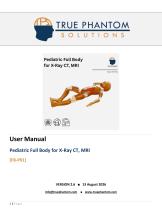
User Manual FB-P01
12 Pages
Other True Phantom Solutions products
X-Ray CT, MRI


Related Searches
- Calibration phantom
- Tomography test phantom
- Radiography test phantom
- CT scan test phantom
- General purpose test phantom
- Ultrasound imaging test phantom
- Torso test phantom
- Head test phantom
- MRI test phantom
- Radiation therapy test phantom
- Breast test phantom
- Pediatric test phantom
- Abdomen test phantom
- Pelvis test phantom
- Skull test phantom
- Whole body test phantom
- Leg test phantom
- Lung test phantom
- Brain test phantom
- Arm test phantom
*Prices are pre-tax. They exclude delivery charges and customs duties and do not include additional charges for installation or activation options. Prices are indicative only and may vary by country, with changes to the cost of raw materials and exchange rates.
About MedicalExpo
MedicalExpo is a marketplace that offers B2B players a complete experience, from product sourcing to purchase. MedicalExpo is an entity of VirtualExpo Group.
Are you a buyer?
Are you a supplier?