


- Laboratory
- Medical research
- Inovenso
Nanofiber electrospinning machine Nanospinner 24for researchmulti-nozzle


Add to favorites
Compare this product
Characteristics
- Applications
- for research, nanofiber
- Other characteristics
- multi-nozzle
Description
Overview
The gas-shield electrospinning nozzle system delays solvent evaporation by surrounding the spinning jet with a solvent-saturated gas stream. This control of the local vapor atmosphere is intended for solutions containing fast‑evaporating solvents and for high‑throughput multi‑jet electrospinning setups.
Enhanced Fiber Quality
A controlled solvent-saturated gas environment stabilizes jet stretching and solidification, producing more uniform fiber diameter and morphology while preserving polymer solution integrity throughout flight to the collector.
Versatility
The system is compatible with common gases (air, nitrogen, inert gases) and can be adjusted for different solvent systems and polymer formulations, making it adaptable to a range of materials and process conditions.
Improved Process Efficiency
Maintaining a stable solvent atmosphere reduces tip clogging and jet instabilities, enabling smoother continuous operation, reduced downtime, and improved effective production rates in multi‑needle configurations.
How It Works
Nitrogen (or chosen gas) is fed from a gas source into a reactor containing solvent, producing a solvent‑saturated gas stream. The saturated gas passes through an airspeed regulator to the gas‑shield nozzle mounted on the electrospinning device. The nozzle has a central outlet for the polymer solution and an annular gas exit that envelopes the solution jet with solvent‑saturated gas, delaying evaporation until the jet reaches the collector.
More Information from Literature
Notes
Other gas‑assisted modes reported include bubble‑based or pulsed gas electrospinning; selection of method depends on target application, solvent volatility and polymer system.
Technical specifications
The gas-shield electrospinning nozzle system delays solvent evaporation by surrounding the spinning jet with a solvent-saturated gas stream. This control of the local vapor atmosphere is intended for solutions containing fast‑evaporating solvents and for high‑throughput multi‑jet electrospinning setups.
Enhanced Fiber Quality
A controlled solvent-saturated gas environment stabilizes jet stretching and solidification, producing more uniform fiber diameter and morphology while preserving polymer solution integrity throughout flight to the collector.
Versatility
The system is compatible with common gases (air, nitrogen, inert gases) and can be adjusted for different solvent systems and polymer formulations, making it adaptable to a range of materials and process conditions.
Improved Process Efficiency
Maintaining a stable solvent atmosphere reduces tip clogging and jet instabilities, enabling smoother continuous operation, reduced downtime, and improved effective production rates in multi‑needle configurations.
How It Works
Nitrogen (or chosen gas) is fed from a gas source into a reactor containing solvent, producing a solvent‑saturated gas stream. The saturated gas passes through an airspeed regulator to the gas‑shield nozzle mounted on the electrospinning device. The nozzle has a central outlet for the polymer solution and an annular gas exit that envelopes the solution jet with solvent‑saturated gas, delaying evaporation until the jet reaches the collector.
More Information from Literature
- Enhanced production rate: Gas‑assisted electrospinning has been reported to increase production rates substantially (examples indicate potential increases of ~30–50× compared with traditional electrospinning) while reducing average fiber diameter and narrowing size distribution, indicating industrial scalability potential.
- Uniform production without clogging: Gas assistance in multi‑jet systems reduces mutual jet repulsion, mechanically helps clear needle/nozzle tips and minimizes clogging; high production rates yield localized, uniform deposited fibers without complex additional electrodes.
- Solvent saturation via vaporization: Supplying solvent‑saturated gas around the jet delays solvent evaporation and can promote formation of targeted structures (for example porous nanostructures) by matching the vapor atmosphere to the spinning solvent.
Notes
Other gas‑assisted modes reported include bubble‑based or pulsed gas electrospinning; selection of method depends on target application, solvent volatility and polymer system.
Technical specifications
- Primary function: delay solvent evaporation during electrospinning to improve fiber formation and uniformity.
- Compatible gases: air, nitrogen, inert gases.
- Solvent‑saturation method: reactor where gas contacts solvent to produce a solvent‑saturated gas stream.
- Gas control: airspeed regulator to control gas flow to the nozzle.
- Nozzle design: central outlet for electrospinning solution surrounded by annular gas exit (gas‑shield nozzle) to envelop the solution jet.
- Benefits: improved fiber quality, reduced clogging, improved process stability and higher effective production rates.
- Target use: solutions with fast‑evaporating solvents and multi‑jet/multi‑needle electrospinning setups.
VIDEO
Catalogs
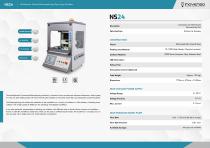
Nanospinner24
2 Pages
Other Inovenso products
Options For Electrospinning/Electrospraying Machines


*Prices are pre-tax. They exclude delivery charges and customs duties and do not include additional charges for installation or activation options. Prices are indicative only and may vary by country, with changes to the cost of raw materials and exchange rates.
About MedicalExpo
MedicalExpo is a marketplace that offers B2B players a complete experience, from product sourcing to purchase. MedicalExpo is an entity of VirtualExpo Group.
Are you a buyer?
Are you a supplier?