


Fully-automatic filling machine Cellana L1robotizedperistalticline-type


Add to favorites
Compare this product
Characteristics
- Operational mode
- fully-automatic, peristaltic, robotized
- Type
- line-type
- Configuration
- compact, modular
- Product applications
- for liquids, for sterile materials
- Container type
- for vials
- Application domain
- for the pharmaceutical industry, for cleanrooms, for cellular therapy, for gene therapy
- Other characteristics
- aseptic, with isolator, with peristaltic pump
- Options
- with capping system, high-throughput
- Production capacity
Min.: 0 p/h
Max.: 500 p/h
- Width
2,000 mm
(78.74 in)- Height
3,000 mm
(118.11 in)- Depth
142 cm
(56 in)
Description
Overview
The Cellana L1 is an automated isolator fill‑finish line by SKAN for AT‑Closed Vial® primary packaging. It delivers a fully closed aseptic filling process with integrated H2O2 decontamination, nanox catalyst exhaust control and six‑axis robotic handling to ensure sterility control, GMP compliance and reproducible high‑accuracy filling.
Key features
Application
Process flow (primary steps)
Product highlights
Regulatory & quality aspects
Technical specifications
The Cellana L1 is an automated isolator fill‑finish line by SKAN for AT‑Closed Vial® primary packaging. It delivers a fully closed aseptic filling process with integrated H2O2 decontamination, nanox catalyst exhaust control and six‑axis robotic handling to ensure sterility control, GMP compliance and reproducible high‑accuracy filling.
Key features
- Automated robotic filling: fully automated operations minimizing manual interventions and contamination risks while ensuring repeatable dosing accuracy.
- Sterility assurance: AT‑Closed Vial® ecosystem combined with integrated skanfog H₂O₂ decontamination and nanox catalyst for validated decontamination and controlled exhaust.
- Minimized contamination risk: bulk product remains outside the isolator and connects aseptically via the AT‑Port aseptic liquid transfer system.
- Regulatory support: designed for cGMP and 21 CFR Part 11; supports Annex 1‑compliant process design.
- Single‑use fluid path: disposable filling kits and closures reduce cleaning validation scope and protect product integrity.
- Flexible vial sizes: compatible with AT‑Closed Vial® sizes 1–50 ml.
- Scalable modular platform: enables clinical‑to‑commercial transfer and replication for higher throughput.
- Fast turnaround: rapid decontamination cycles (<20 minutes) and shortened changeover due to minimal format parts.
Application
- Intended for biopharmaceutical manufacturers, CROs and C(D)MOs handling ATMPs.
- Designed for cell & gene therapy and other biologics including viral vectors, plasmid DNA and mRNA.
- Suitable for vaccines, personalized medicines and sterile biotech products requiring strict aseptic control.
- Facilitates scale‑up from clinical small batches to automated mid‑ and large‑scale production.
Process flow (primary steps)
- Material transfer: vials and consumables introduced via a rapid decontamination airlock into the isolator environment.
- Bulk connection: aseptic connection of bulk product outside the isolator using the AT‑Port System.
- Setup & fluid path preparation: fluid connections completed inside the decontaminated chamber via glove access.
- Filling: non‑coring needle fills through the stopper; peristaltic pump dosing provides high accuracy.
- Laser resealing: stopper resealed with a ~1‑second laser shot.
- Capping: snap‑fit AT‑Cap closure applied.
- Extraction: completed AT‑Nest units removed via the exit transfer system.
Product highlights
- Compact modular footprint optimized for minimal cleanroom space requirement.
- Six‑axis cleanroom robot performs filling, laser resealing and capping without manual handling.
- Enables installation in Grade C/D facilities due to isolator‑based sterility control; supports RABS option for Grade B.
- Modular design supports duplication for increased throughput and clinical‑to‑commercial scale‑up.
Regulatory & quality aspects
- Annex 1‑compatible process design minimizing interventions and contamination risk.
- Container closure integrity (CCI) validated by dye ingress, CT scan and headspace analysis as examples.
- Primary packaging materials meet relevant pharmacopoeial requirements (USP/EP).
Technical specifications
- Commercial name: Cellana L1
- Brand: SKAN
- Standard working chamber (W × D × H): 2000 × 1417 × 3000 mm
- Footprint: compact, modular design for minimal cleanroom space
- Containers: AT‑Closed Vial® (1–50 ml)
- Output / Throughput: up to 500 AT‑Closed Vial® per hour
- Filling volume range: 0.1–45 ml
- Filling line type: AT (AT‑Closed Vial® ecosystem)
- Consumables: single‑use filling kits and closures
- Robotics: six‑axis robotic handling with short changeover times
- Filling technology: peristaltic pump dosing; non‑coring needle filling through stopper
- Decontamination: integrated skanfog H₂O₂ system and nanox catalyst; rapid cycles <20 minutes
- Working chamber classification: Grade A (ISO 5)
- Recommended facility cleanroom: Grade C/D (isolator); RABS option for Grade B
- Automation & compliance: 21 CFR Part 11 and Annex 1 compatible
- Additional components: AT‑Port System, AT‑Cap, AT‑Assembly single‑use transfer system
- Laser resealing: ~1 second laser shot
VIDEO
Catalogs
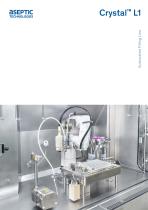
Crystal™ L1
6 Pages
Other Skan products
Pharma & Biotech Solutions


Related Searches
- Filler for the pharmaceutical industry
- Automatic filler
- Liquid filler
- Vial filler
- Aseptic filler
- Compact filler
- Semi-automatic filler
- Filler with capping system
- In-line filler
- Peristaltic filler
- Filling machine with isolator
- Filling machine with touchscreen
- Robotized filling machine
- Fully-automatic filler
- Production filling machine
- Cleanroom filling machine
- Computer-controlled filling machine
- Filling machine with peristaltic pump
- High-throughput filling machine
- Sterile material filling machine
*Prices are pre-tax. They exclude delivery charges and customs duties and do not include additional charges for installation or activation options. Prices are indicative only and may vary by country, with changes to the cost of raw materials and exchange rates.