



- Rehabilitation
- Kinesitherapy, Physiotherapy
- Knee isokinetic dynamometer
- Guangzhou Yeecon Medical Equipment Industrial
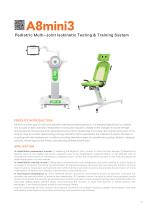
Lower limb isokinetic dynamometer A8mini3knee

Add to favorites
Compare this product
Characteristics
- Area of the body
- lower limb, knee
Description
Multi-joint isokinetic training and testing device designed for pediatric rehabilitation, enabling early isokinetic training and objective evaluation.
Product introduction
Application — roles in rehabilitation assessment
Main functions in rehabilitation training
Role in neurological rehabilitation
Clinical relevance
Technical specifications
Product introduction
- A8mini3 is a multi-joint isokinetic training and testing system developed for children to support early rehabilitation and development assessment.
- The device converts the exercise force generated by the child into torque and controls joint movement at preset angular speeds while recording isokinetic motion parameters for objective analysis.
Application — roles in rehabilitation assessment
- Quantify the degree of joint, muscle or nerve impairment to inform clinical decision-making.
- Use baseline measurements from the healthy side to set expected rehabilitation targets for the affected side.
- Monitor rehabilitation progress in real time and evaluate the effectiveness of treatment protocols.
Main functions in rehabilitation training
- Simultaneous training of agonist and antagonist muscles to generate torque across the full range of motion, facilitating targeted strength recovery.
- Improve neuromuscular function and accessory tissue conditioning; promote fluid circulation, pain relief and joint nutrition.
- Enhance local blood flow and support reduction of sterile inflammation.
- Increase joint stability and improve motor control for functional recovery.
Role in neurological rehabilitation
- Repetitive sensory input and repeated isokinetic movements stimulate neuroplastic adaptations in the nervous system.
- Support gradual restoration of central control over impaired muscle groups and contribute to recovery of gait, balance and lower-limb function in neurological patients.
Clinical relevance
- Applicable to postoperative and post-traumatic knee conditions (patellar fractures, patellar chondropathy, total knee arthroplasty, post-arthroscopy meniscal injury, traumatic knee stiffness) and pediatric musculoskeletal rehabilitation.
Technical specifications
- Model: A8mini3
- Device type: Pediatric multi-joint isokinetic training and testing system
- Intended users: Children (early rehabilitation and development assessment)
- Principle: Converts exercise force to torque and controls joint movement at preset isokinetic speeds
- Data collected: Isokinetic motion parameters for strength, torque and movement analysis
- Main purposes: Early isokinetic rehabilitation training, objective evaluation, muscle growth/development analysis and scientific exercise guidance
Catalogs
Exhibitions
Meet this supplier at the following exhibition(s):

MEDICA 2026
16-19 Nov 2026 Düsseldorf (Germany) Hall 4 - Stand J18
Other Guangzhou Yeecon Medical Equipment Industrial products
Pediatric rehabilitation


Related Searches
- Yeecon electric stimulator
- TENS physiotherapy
- Yeecon rehabilitation system
- EMS physiotherapy
- Yeecon ESWT unit
- Pressure therapy unit
- Yeecon orthopedic treatment ESWT unit
- Yeecon computer-assisted rehabilitation system
- Yeecon robotic rehabilitation system
- Ultrasound stimulator physiotherapy
- Magnetic therapy unit kinesitherapy
- Continuous passive motion device
- Table-top ESWT unit
- Bobath table
- Electric massager
- Leg pressure therapy unit
- Yeecon rehabilitation system with serious games
- Yeecon gait rehabilitation system
- Yeecon hand mobility rehabilitation system
- Yeecon rehabilitation system with interactive workout
*Prices are pre-tax. They exclude delivery charges and customs duties and do not include additional charges for installation or activation options. Prices are indicative only and may vary by country, with changes to the cost of raw materials and exchange rates.
About MedicalExpo
MedicalExpo is a marketplace that offers B2B players a complete experience, from product sourcing to purchase. MedicalExpo is an entity of VirtualExpo Group.
Are you a buyer?
Are you a supplier?