



- Rehabilitation
- Kinesitherapy, Physiotherapy
- Balance rehabilitation system
- Guangzhou Yeecon Medical Equipment Industrial
Ankle mobility rehabilitation system A3miniSpostureknee mobilitygait

Add to favorites
Compare this product
Characteristics
- Therapy type
- ankle mobility, posture, knee mobility, gait, limbs mobility, leg mobility, balance
- Technology
- virtual, computer-assisted, robotic
- Patient type
- pediatric
- Options
- with virtual reality system, with gamification applications, with serious games, with interactive workout
Description
Overview
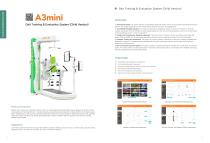
The A3miniS Pediatric Gait Training and Evaluation System is a clinical device designed to assess, quantify and train walking patterns in children. It provides objective gait metrics and generates clinical assessment reports to support therapists in diagnosis and therapy planning. Based on quantitative evaluation results, the system enables individualized training protocols to progressively improve walking function and gait quality.
Indications
Functional Features
Functions of Pediatric Lower Limb Rehabilitation Robot
Diversified Immersive Scene Interactive Games
Technical Specifications
The A3miniS Pediatric Gait Training and Evaluation System is a clinical device designed to assess, quantify and train walking patterns in children. It provides objective gait metrics and generates clinical assessment reports to support therapists in diagnosis and therapy planning. Based on quantitative evaluation results, the system enables individualized training protocols to progressively improve walking function and gait quality.
Indications
- Pediatric lower-extremity dysfunction and gait abnormalities due to cerebral palsy or spinal cord injury.
- Conditions affecting pediatric gait such as muscular atrophy, myasthenia, neuromuscular disorders and motor coordination impairments.
Functional Features
- Child-focused exterior design with bright colors and friendly graphics.
- Adjustable partial weight-bearing system that reduces joint and muscle load; padded suspension contact points for comfort.
- Fully adjustable wearable harness accommodating growth and various body shapes.
- Real-time tracking and assessment with instant data feedback and analytical reports for therapists.
- Immersive, gamified training modules to increase engagement and adherence.
Functions of Pediatric Lower Limb Rehabilitation Robot
- Quantitative assessment using integrated sensors and analytics to produce objective progress indicators and assessment reports.
- Assisted mobilization and stable support to reinforce physiological gait patterns, postural control, balance and coordination.
- Enable increased training volume and intensity via customizable assistance for repetitive practice to promote muscle activation and neural recovery.
- Individualized rehabilitation protocols with dynamic parameter adjustment based on each child’s muscle strength, balance and gait characteristics.
- Real-time motion feedback and corrective prompts to improve movement accuracy.
- Motivation enhancement through interactive, game-based tasks.
Diversified Immersive Scene Interactive Games
- Clinical training modes designed for progressive skill development.
- Intelligent real-time tracking and performance assessment.
- Efficient evaluation of gait parameters and joint range of motion.
Technical Specifications
- Maximum patient height: 150 cm
- Maximum patient weight: 135 kg
- Thigh length adjustment (greater trochanter to knee): 25–39 cm
- Lower leg length adjustment (knee to ankle): 22–30 cm
- Hip joint angle range: 30°–50°
- Knee joint angle range: 50°–80°
- Guidance force adjustment range: 1%–100%
- Treatment time: 0–99 min
- Spasm sensitivity: three adjustable levels — low, medium, high
Catalogs
Exhibitions
Meet this supplier at the following exhibition(s):

MEDICA 2026
16-19 Nov 2026 Düsseldorf (Germany) Hall 4 - Stand J18
Other Guangzhou Yeecon Medical Equipment Industrial products
Pediatric rehabilitation


Related Searches
- Yeecon electric stimulator
- TENS physiotherapy
- Yeecon rehabilitation system
- EMS physiotherapy
- Yeecon ESWT unit
- Pressure therapy unit
- Yeecon orthopedic treatment ESWT unit
- Yeecon computer-assisted rehabilitation system
- Yeecon robotic rehabilitation system
- Ultrasound stimulator physiotherapy
- Magnetic therapy unit kinesitherapy
- Continuous passive motion device
- Table-top ESWT unit
- Bobath table
- Electric massager
- Leg pressure therapy unit
- Yeecon rehabilitation system with serious games
- Yeecon gait rehabilitation system
- Yeecon hand mobility rehabilitation system
- Yeecon rehabilitation system with interactive workout
*Prices are pre-tax. They exclude delivery charges and customs duties and do not include additional charges for installation or activation options. Prices are indicative only and may vary by country, with changes to the cost of raw materials and exchange rates.
About MedicalExpo
MedicalExpo is a marketplace that offers B2B players a complete experience, from product sourcing to purchase. MedicalExpo is an entity of VirtualExpo Group.
Are you a buyer?
Are you a supplier?