


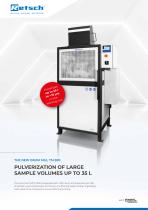
Rotary drum mill TM 500batchimpactfor sample preparation


Add to favorites
Compare this product
Characteristics
- Technology
- rotary drum, batch, impact
- Applications
- for sample preparation, laboratory, for research
- Other characteristics
- ultrafine, stainless steel, variable-speed, dry milling
Description
Overview
The TM 500 is a laboratory drum (ball) mill designed for grinding large batch volumes up to 35 L in a 150 L drum. It accepts feed sizes up to 20 mm and reaches final fineness down to <15 µm by combined impact and friction. Variable speed (10–50 rpm), multiple grinding ball sizes and runs up to 100 h enable process adaptation and reproducible results. A FoodGrade version with stainless steel 316L drum and hopper is available for contamination-sensitive applications.
Operation and control
Ergonomic handling with feed hopper and optional separating screen for balls/sample. The drum is emptied via electronic tilt. Grinding time, start delay and interval mode are set and saved on the display. Programmable breaks and forward/reverse intervals prevent overheating and caking. Emergency stop increases operator safety. A grid funnel is available to separate balls from product.
Grinding examples / Performance
Example — Gravel grinding: 40 kg (27 L) sample with 80 kg (17.6 L) of 20 mm balls at 50 rpm over several hours. Measured D90: 2 h = 98 µm; 4 h = 37 µm; 6 h = 21 µm; 8 h = 15 µm.
Typical sample materials
Optional features
FoodGrade execution with stainless steel 316L drum and hopper for heavy-metal-free processing. Grinding balls available in 10 mm, 20 mm and 30 mm (1.4404 steel). Optional sieve section (mesh inserts, collecting vessels) for ball/sample separation.
Functional principle
The sample and grinding balls are placed in the rotating horizontal drum. Size reduction is achieved by impact and friction; larger balls promote breakage, smaller balls increase final fineness. Process parameters (ball size, speed, time, intervals) control particle size distribution.
Technical specifications
*depending on feed material and instrument configuration/settings
The TM 500 is a laboratory drum (ball) mill designed for grinding large batch volumes up to 35 L in a 150 L drum. It accepts feed sizes up to 20 mm and reaches final fineness down to <15 µm by combined impact and friction. Variable speed (10–50 rpm), multiple grinding ball sizes and runs up to 100 h enable process adaptation and reproducible results. A FoodGrade version with stainless steel 316L drum and hopper is available for contamination-sensitive applications.
Operation and control
Ergonomic handling with feed hopper and optional separating screen for balls/sample. The drum is emptied via electronic tilt. Grinding time, start delay and interval mode are set and saved on the display. Programmable breaks and forward/reverse intervals prevent overheating and caking. Emergency stop increases operator safety. A grid funnel is available to separate balls from product.
Grinding examples / Performance
Example — Gravel grinding: 40 kg (27 L) sample with 80 kg (17.6 L) of 20 mm balls at 50 rpm over several hours. Measured D90: 2 h = 98 µm; 4 h = 37 µm; 6 h = 21 µm; 8 h = 15 µm.
Typical sample materials
- activated carbon
- alloys
- bentonite
- bones
- carbon fibers
- catalysts
- cellulose
- cement clinker
- ceramics
- chemical products
- clay minerals
- coal, coke
- compost
- concrete
- electronic scrap
- fibres
- gypsum
- glass
- hair
- hydroxyl apatite
- kaolin
- lime stone
- metal oxides
- minerals, ores
- paint and varnish
- paper
- pharmaceutical products
- pigments
- plants
- polymers
- quartz
- seeds
- semi-precious stones
- sewage sludge
- slag
- soil
- tissue
- tobacco
- waste
- wood
Optional features
FoodGrade execution with stainless steel 316L drum and hopper for heavy-metal-free processing. Grinding balls available in 10 mm, 20 mm and 30 mm (1.4404 steel). Optional sieve section (mesh inserts, collecting vessels) for ball/sample separation.
Functional principle
The sample and grinding balls are placed in the rotating horizontal drum. Size reduction is achieved by impact and friction; larger balls promote breakage, smaller balls increase final fineness. Process parameters (ball size, speed, time, intervals) control particle size distribution.
Technical specifications
- Applications: pulverizing, mixing, dry grinding
- Fields: agriculture, biology, chemistry, construction materials, engineering/electronics, environment/recycling, geology/metallurgy, glass/ceramics, medicine/pharmaceuticals
- Feed material: soft, hard, brittle, fibrous
- Size reduction principle: friction, impact
- Material feed size*: < 20 mm
- Final fineness*: < 15 µm
- Batch size / feed quantity*: min. 1 L / max. 35 L
- Rotation speed: 10 - 50 min-1
- No. of grinding stations: 1
- Grinding tool materials: hardened steel, stainless steel, 316L
- Grinding drum size: 150 L
- Grinding time setting: digital, 00:00:01 to 99:59:59
- Drive: 3-phase asynchronous motor with frequency converter
- Drive power: 2.2 kW
- Electrical supply: 200-240 V, 50/60 Hz
- Power connection: 1-phase
- Protection code: IP 30
- Power consumption: ~ 2200 W (VA)
- Dimensions W x H x D (closed): 1100 x 1604 x 936 mm
- Net weight: ~ 460 kg
- Standards: CE
*depending on feed material and instrument configuration/settings
VIDEO
Catalogs

Other RETSCH products
Ball Mills


Related Searches
- Agitator
- Benchtop stirrer
- Digital stirrer
- Retsch laboratory mill
- Retsch pharmaceutical industry mill
- Retsch sample mill
- Retsch tabletop mill
- Benchtop sieve shaker
- Sample preparation sieve shaker
- Digital sieve shaker
- Retsch rotor mill
- Retsch ball bearing mill
- Retsch batch mill
- Retsch continuous mill
- Dryer for the pharmaceutical industry
- Retsch impact mill
- Retsch mill for the food industry
- Fluid bed dryer
- High-speed mill
- Retsch knife mill
*Prices are pre-tax. They exclude delivery charges and customs duties and do not include additional charges for installation or activation options. Prices are indicative only and may vary by country, with changes to the cost of raw materials and exchange rates.
About MedicalExpo
MedicalExpo is a marketplace that offers B2B players a complete experience, from product sourcing to purchase. MedicalExpo is an entity of VirtualExpo Group.
Are you a buyer?
Are you a supplier?