

- Laboratory
- Laboratory medicine
- Optical microscope
- Leica Microsystems


- Company
- Products
- Catalogs
- News & Trends
- Exhibitions
Compound microscope DM6 M LIBSinspectionfor researchfor materials research

Add to favorites
Compare this product
Characteristics
- Type
- compound
- Applications
- inspection, for research, for materials research, for environmental analysis
- Microscope head
- trinocular
- Options and accessories
- with color camera
- Other characteristics
- digital camera, automated
- Magnification
Max.: 100 x
Min.: 1.25 x
Description
Overview
The DM6 M LIBS is a materials analysis solution that integrates microscopy and Laser Induced Breakdown Spectroscopy (LIBS) to deliver simultaneous visual and qualitative chemical analysis in a single workflow. The integrated LIBS delivers the chemical fingerprint of the microstructure visible in the microscope image within seconds, enabling rapid decision making and significantly reduced analysis time compared to conventional SEM/EDS workflows.
Key benefits
Visual & chemical material inspection – 2-in-1
LIBS workflow and capabilities
The LIBS module uses a laser pulse to create a plasma at the targeted spot; the emitted light spectrum (atomic line spectral emissions) is analysed to identify elements present. The software compares spectra with a known dataset and can be extended with user-acquired material spectra. The ablation principle also enables micro-drilling (µ-drilling) for depth profiling and layer analysis as well as surface cleaning.
Typical LIBS workflow advantages
Applications and use cases
The DM6 M LIBS is suited for rapid structural and elemental/chemical analysis of material phases such as minerals, alloys, ceramics and other engineered materials. Use cases include: cleanliness analysis of components and filter samples (identification of contaminant particles and their source), depth profile and layer analysis (e.g., multi-coated/painted metals), microstructure composition evaluation, industrial QA/QC, and materials research.
Microscope contribution
The base DM6 M microscope provides a wide objective magnification range and multiple contrast techniques for easy visualization of fine structure in true colours, enabling identification of regions of interest for LIBS analysis. The system supports observation with objective magnifications from low (1.25x) to high (100x), multiple contrast methods and image capture via eyepieces or camera.
Cleanliness analysis
When combined with Cleanliness Expert analysis software, the 2-in-1 system enables visual and chemical inspection of filter samples in a single instrument and workflow, facilitating quicker identification of contamination sources.
Upgrade and retrofit
Existing DM6000 M or DM6 M compound microscopes can be retrofitted with the LIBS module to obtain the 2-in-1 functionality, offering an option to upgrade existing microscopes rather than replacing them.
Technical specifications
The DM6 M LIBS is a materials analysis solution that integrates microscopy and Laser Induced Breakdown Spectroscopy (LIBS) to deliver simultaneous visual and qualitative chemical analysis in a single workflow. The integrated LIBS delivers the chemical fingerprint of the microstructure visible in the microscope image within seconds, enabling rapid decision making and significantly reduced analysis time compared to conventional SEM/EDS workflows.
Key benefits
- Rapid, precise material analysis combining visual microscopy and chemical spectroscopy in one instrument
- Save up to 90% of analysis time versus conventional electron microscopy/EDS workflows
- Single-click LIBS analysis: chemical fingerprint delivered within a second
- No SEM-style sample preparation, no transfer between systems, no system re-adjustment, no relocating the region of interest
Visual & chemical material inspection – 2-in-1
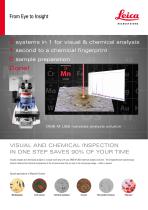
- 2 systems in 1 for visual and chemical analysis
- 1 second to a chemical fingerprint
- 0 sample preparation
LIBS workflow and capabilities
The LIBS module uses a laser pulse to create a plasma at the targeted spot; the emitted light spectrum (atomic line spectral emissions) is analysed to identify elements present. The software compares spectra with a known dataset and can be extended with user-acquired material spectra. The ablation principle also enables micro-drilling (µ-drilling) for depth profiling and layer analysis as well as surface cleaning.
Typical LIBS workflow advantages
- No sample preparation nor transfer required
- No system adjustment required
- No relocating the region of interest (ROI)
Applications and use cases
The DM6 M LIBS is suited for rapid structural and elemental/chemical analysis of material phases such as minerals, alloys, ceramics and other engineered materials. Use cases include: cleanliness analysis of components and filter samples (identification of contaminant particles and their source), depth profile and layer analysis (e.g., multi-coated/painted metals), microstructure composition evaluation, industrial QA/QC, and materials research.
Microscope contribution
The base DM6 M microscope provides a wide objective magnification range and multiple contrast techniques for easy visualization of fine structure in true colours, enabling identification of regions of interest for LIBS analysis. The system supports observation with objective magnifications from low (1.25x) to high (100x), multiple contrast methods and image capture via eyepieces or camera.
Cleanliness analysis
When combined with Cleanliness Expert analysis software, the 2-in-1 system enables visual and chemical inspection of filter samples in a single instrument and workflow, facilitating quicker identification of contamination sources.
Upgrade and retrofit
Existing DM6000 M or DM6 M compound microscopes can be retrofitted with the LIBS module to obtain the 2-in-1 functionality, offering an option to upgrade existing microscopes rather than replacing them.
Technical specifications
- Product type: DM6 M LIBS material analysis microscope (microscopy + integrated LIBS)
- Analysis method: Laser Induced Breakdown Spectroscopy (LIBS) for qualitative elemental identification
- Typical chemical analysis time: ~1 second to obtain a chemical fingerprint at the targeted spot
- Sample preparation: none required for LIBS inspection workflow
- Microscope magnification range: objective range from 1.25x to 100x (observation range)
- Functional capabilities: simultaneous visual (optical) and chemical inspection; single-click LIBS trigger
- Depth profiling / layer analysis: enabled by µ-drilling (micro-ablation) using LIBS
- Applications: minerals, alloys, ceramics, coatings, cleanliness/filter analysis, microstructure evaluation, industrial QA/QC
- Software: spectrum comparison with reference dataset; dataset expandable by user
- Workflow advantages: eliminates transfer between devices, reduces work steps and analysis time vs SEM/EDS, minimizes labor-intensive prep
- Integration: option to retrofit DM6000 M / DM6 M microscopes with LIBS module for 2-in-1 solution
- Deliverable outputs: optical images (eyepiece/camera) and elemental/qualitative composition derived from LIBS spectra
Catalogs
DM6 M LIBS
2 Pages
Other Leica Microsystems products
Upright Light Microscopes


Related Searches
- Leica analysis software
- Leica microscope
- Leica optical microscope
- Leica laboratory microscope
- Leica benchtop microscope
- Leica visualization software
- Control software
- Leica LED microscope
- Reporting software
- Leica laboratory software
- Windows medical software
- Leica CMOS camera
- Leica camera with USB port
- Automated software
- Leica LED light source
- Acquisition software
- Scan software
- Measurement software
- Leica biology microscope
- Education software
*Prices are pre-tax. They exclude delivery charges and customs duties and do not include additional charges for installation or activation options. Prices are indicative only and may vary by country, with changes to the cost of raw materials and exchange rates.