


Electric stimulator PhysioGo.Lite COMBOultrasound stimulatortabletopEMS

Add to favorites
Compare this product
Characteristics
- Type
- electric stimulator, ultrasound stimulator
- Ergonomics
- tabletop
- Type of electrical stimulation
- TENS, EMS
- Weight
3 kg
(6.61 lb)- Length
25 cm
(9.8 in)- Height
16.5 cm
(6.5 in)- Depth
27 cm
(10.6 in)
Description
Overview
Compact multifunctional device combining electrotherapy, ultrasound therapy (sonotherapy) and combined therapy. Compact size and weight, integrated treatment-program database and optional Li‑ion battery enable portable use without mains connection.
Key benefits for the patient
LIPUS therapy
Low Intensity Pulsed Ultrasound (LIPUS) available to stimulate bone regeneration, tendon repair, nerve regeneration and healing in acute and subacute inflammation.
Safety
Automatic self-test at start-up verifies components and reports errors. During sonotherapy the device monitors ultrasound head contact to ensure effective dosing. Electrode wear check is available before electrotherapy sessions.
Key benefits for the clinician
Database and programmability
Comprehensive preset and user-program system: database of built-in therapeutic procedures (304 procedures), an encyclopedia with methodology, predefined counts and user-program limits.
Ultrasound applicators
Additional functional highlights
Technical specifications
Compact multifunctional device combining electrotherapy, ultrasound therapy (sonotherapy) and combined therapy. Compact size and weight, integrated treatment-program database and optional Li‑ion battery enable portable use without mains connection.
Key benefits for the patient
- Supports electrotherapy, ultrasound (sonotherapy) and simultaneous combined therapy.
- Electrotherapy: uni- and bipolar low- and medium-frequency currents including IG pulses, EMS, H-waves, exponential pulses and Hufschmidt stimulation.
- Sonotherapy: ultrasound at 1 MHz (deep) and 3 MHz (superficial); continuous or pulsed emission; applicators GU-1 (1 cm2), GU-5 (5 cm2) and hands-free SnG (17.3 cm2 or 34.6 cm2 in dual-section mode).
- Supports phonophoresis, LIPUS and simultaneous electrotherapy + ultrasound protocols.
LIPUS therapy
Low Intensity Pulsed Ultrasound (LIPUS) available to stimulate bone regeneration, tendon repair, nerve regeneration and healing in acute and subacute inflammation.
Safety
Automatic self-test at start-up verifies components and reports errors. During sonotherapy the device monitors ultrasound head contact to ensure effective dosing. Electrode wear check is available before electrotherapy sessions.
Key benefits for the clinician
- 5" color touch display for intuitive operation.
- Three independent treatment channels with full galvanic isolation to prevent interference during simultaneous modes.
- Treatment-program database: built-in library with methodology, create/save/rename user programs and sequences, favourite lists.
Database and programmability
Comprehensive preset and user-program system: database of built-in therapeutic procedures (304 procedures), an encyclopedia with methodology, predefined counts and user-program limits.
Ultrasound applicators
- GU-1: 1 cm² (1 MHz)
- GU-5: 5 cm² (1 MHz)
- SnG: 17.3 cm² (1 MHz); two SnG heads can operate simultaneously (34.6 cm² in dual-section mode)
Additional functional highlights
- Electrode test and intensity adjustment in the patient circuit (simultaneous or separate channel adjustment).
- Manual and program operation modes.
- Preset programs selectable by name or medical field.
- LIPUS therapy and treatment statistics available.
- Adjustable buzzer volume.
- Optional Li‑ion battery for portable operation.
Technical specifications
- Product code: A-UE-AST-PLC
- Commercial name: PhysioGo.Lite COMBO
- Display: 5" color touch panel
- Independent treatment channels: 3 (full galvanic isolation)
- Battery: Li‑Ion optional (2100 mAh)
- Dimensions: 25.0 x 27.0 x 16.5 cm
- Weight: max. 3 kg
- Mains supply: 100-240 VAC, 50/60 Hz
- Built-in database: 304 procedures; preset counts: electrotherapy 71, ultrasound 156, combined therapy 77
- User-defined programs: up to 50 (electrotherapy); up to 50 per ultrasound applicator; combined therapy user programs 50
- Preset treatment sequences (electrotherapy): 44; user sequences: 10
- Treatment timer (electrotherapy): 1–60 minutes
- Ultrasound timer (on-screen keyboard accuracy 1 s): 30 s – 30 minutes
- Ultrasound frequencies: 1 MHz and 3 MHz
- Ultrasound max intensity: 2 / 3 W/cm²
- Ultrasound pulse frequency: 10–150 Hz (variable step) for GU-1 and GU-5; SnG LIPUS 1 kHz
- Ultrasound features: continuous/pulse emission, water-resistant heads, head contact control (effective treatment time measured), head temperature control and sensitivity calibration
- Electrotherapy modes: CC (constant current) and CV (constant voltage)
- Electrotherapy methods included: isoplanar interferential, dynamic interferential, one-channel AMF interferential, TENS (symmetric, asymmetric, burst, alternating polarization, SP-TENS), Kotz' current, Tonolysis, Hufschmidt stimulation, diadynamic currents (MF, DF, CP, CP-ISO, LP, RS, MM), rectangular/triangular pulses, Ultra Reiz (Träbert’s current), Leduc’s current, Neofaradic pulses, unipolar/bipolar sine surge, microcurrents, medium frequency currents, IG pulses, EMS currents, H-waves, exponential pulses
- Electrotherapy technical parameters (max. current intensity in patient circuit, CC mode): unipolar sine surge 30 mA; galvanic, IG 80 mA; diadynamic 70 mA; bipolar sine surge & Hufschmidt 100 mA; interferential, TENS, SP-TENS, Kotz’, pulsed, MF, tonolysis, EMS, H-waves, Trabert, Leduc and exponential pulses up to 140 mA; microcurrents up to 1000 μA
- Max. voltage amplitude in patient circuit (CV mode): general modes 100 V; TENS, SP-TENS, EMS, H-waves up to 140 V
Catalogs
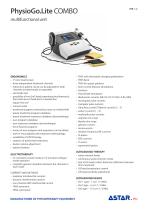
PhysioGo.Lite COMBO
2 Pages
Product Catalogue
136 Pages
Exhibitions
Meet this supplier at the following exhibition(s):
MEDICA 2026
16-19 Nov 2026 Düsseldorf (Germany) Hall 4 - Stand J55
Other ASTAR products
Miltiple therapy units


Related Searches
- Aesthetic medicine laser
- ASTAR diode laser
- Tabletop laser
- ASTAR electric stimulator
- Dermatology laser
- Class 4 laser
- ASTAR TENS physiotherapy
- ASTAR heat therapy unit
- EMS physiotherapy
- Extra-corporeal shockwave therapy unit
- Physical therapy laser
- Microsecond laser
- Pressure therapy unit
- Musculoskeletal disorder ESWT unit
- Physical biostimulation laser
- ASTAR ultrasound diathermy unit
- ASTAR magnetic therapy unit
- Tecar therapy unit
- Table-top ESWT unit
- GaAlAs laser
*Prices are pre-tax. They exclude delivery charges and customs duties and do not include additional charges for installation or activation options. Prices are indicative only and may vary by country, with changes to the cost of raw materials and exchange rates.
About MedicalExpo
MedicalExpo is a marketplace that offers B2B players a complete experience, from product sourcing to purchase. MedicalExpo is an entity of VirtualExpo Group.
Are you a buyer?
Are you a supplier?