



- Company
- Products
- Catalogs
- News & Trends
- Exhibitions
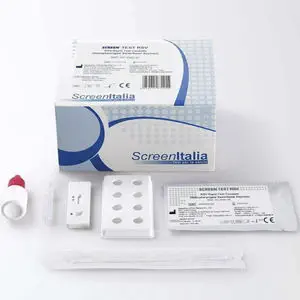
Rapid quality control test SC-0470-25glutamate dehydrogenaseClostridium difficilefeces

Add to favorites
Compare this product
Characteristics
- Application field
- for quality control
- Tested parameter
- glutamate dehydrogenase
- Micro-organism
- Clostridium difficile
- Sample type
- feces
- Analysis mode
- chromatographic immunoassay
- Result display time
10 min
Description
The Clostridium difficile rapid test is a rapid immunochromatographic test for the qualitative detection of Clostridium difficile GDH in human stool samples. The limit of detection was assessed by diluting a purified GDH preparation and the results show that the detected protein concentration is 1ng/mL. The Clostridium test allows the specific detection of C. difficile GDH in faecal samples. Samples with a positive Clostridium test result will require further testing for bacterial toxicity. Clostridium difficile is an anaerobic bacterium that acts as an opportunistic pathogen: it grows in the intestine when the normal flora is altered by antibiotic therapy. Some toxinogenic forms of Clostridium difficile cause infections from mild diarrhea to pseudomembranous colitis, potentially leading to death. The disorder is caused by two toxins produced by the toxinogenic forms of C. difficile: Toxin A (enterotoxin damages tissues) and Toxin B (cytotoxin). Some types produce both toxins A and B, others produce only Toxin B. The potential role of a third (binary) toxin in pathogenicity is still a matter of debate. The use of Glutamate Dehydrogenase (GDH) as an antigenic marker of the proliferation of C. difficile has proven to be very effective since all types produce high amounts of this enzyme. The Clostridium test allows the specific detection of C. difficile GDH in faecal samples. Samples with a positive Clostridium test result will require further testing for bacterial toxicity. The test is ready for use and is based on a membrane technology with colloidal gold. A nitrocellulose membrane is sensitized with an antibody directed against the Clostridium difficile antigen (GDH).
Catalogs

SCREEN CATALOGUES EN
182 Pages
Other SCREEN ITALIA products
Infectious Diseases




Related Searches
- Assay kit
- Blood assay kit
- Immunoassay assay kit
- Rapid lateral flow test
- Blood rapid diagnostic test
- Cassette rapid diagnostic test
- Rapid immunologic test
- Serum rapid diagnostic test
- Plasma rapid diagnostic test
- Virus rapid diagnostic test
- Whole blood rapid diagnostic test
- Respiratory infection test kit
- Infectious disease rapid diagnostic test
- Cassette assay kit
- Lateral flow test kit
- Rapid respiratory infection test
- Urine rapid screening test
- COVID-19 detection kit
- Antigen assay kit
- Bacteria rapid diagnostic test
*Prices are pre-tax. They exclude delivery charges and customs duties and do not include additional charges for installation or activation options. Prices are indicative only and may vary by country, with changes to the cost of raw materials and exchange rates.
About MedicalExpo
MedicalExpo is a marketplace that offers B2B players a complete experience, from product sourcing to purchase. MedicalExpo is an entity of VirtualExpo Group.
Are you a buyer?
Are you a supplier?