



- Company
- Products
- Catalogs
- News & Trends
- Exhibitions
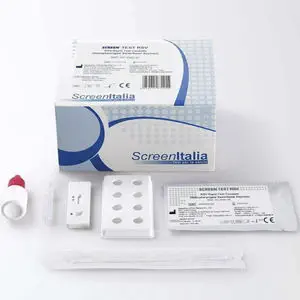
Rapid quality control test SC-0678-25norovirusfeceschromatographic immunoassay

Add to favorites
Compare this product
Characteristics
- Application field
- for quality control
- Micro-organism
- norovirus
- Sample type
- feces
- Analysis mode
- chromatographic immunoassay
Description
The rapid test for Norovirus (Feces) is a rapid immunochromatographic test for the qualitative detection of Norovirus in human stool samples useful in the diagnosis of Norovirus infection. The Norovirus rapid test (Feces) was compared with the RT-PCR method, demonstrating an overall accuracy of 94.29%. The presence of a colored line in the T1 area indicates a positive result for Genogroup 1 while in T2 it indicates a positive result for Genogroup 2, while its absence indicates a negative result. As a procedural control, a line will always appear in the control region (C) to indicate that the correct volume of sample has been used and that the membrane has been soaked. Noroviruses (NoVs) are a genetically diverse group of single-stranded RNA viruses, belonging to the Caliciviridae family. For decades they were called “small round structured viruses” (SRSV) or “Norwalk-like viruses” until their taxonomy was studied using modern molecular techniques. Four antigenic types of SRSV were initially recognized, but more recently three genogroups with the Norovirus genus have been identified. Genogroup 1 and Genogroup 2 are associated with human infections while Genogroup 3 is associated with bovine and swine infection. Noroviruses are a leading cause of acute gastroenteritis worldwide, often causing extremely virulent outbreaks in communities. They are very contagious, with an inoculum of as many as 10 particles that can cause infections. Transmission occurs through ingestion of contaminated food and water and spread from person to person. Transmission is predominantly fecal-oral, but can be inhaled due to aerosol vomitus,
Catalogs

SCREEN CATALOGUES EN
182 Pages
Other SCREEN ITALIA products
Infectious Diseases




Related Searches
- Assay kit
- Blood assay kit
- Immunoassay assay kit
- Rapid lateral flow test
- Blood rapid diagnostic test
- Cassette rapid diagnostic test
- Rapid immunologic test
- Serum rapid diagnostic test
- Plasma rapid diagnostic test
- Virus rapid diagnostic test
- Whole blood rapid diagnostic test
- Respiratory infection test kit
- Infectious disease rapid diagnostic test
- Cassette assay kit
- Lateral flow test kit
- Rapid respiratory infection test
- Urine rapid screening test
- COVID-19 detection kit
- Antigen assay kit
- Bacteria rapid diagnostic test
*Prices are pre-tax. They exclude delivery charges and customs duties and do not include additional charges for installation or activation options. Prices are indicative only and may vary by country, with changes to the cost of raw materials and exchange rates.
About MedicalExpo
MedicalExpo is a marketplace that offers B2B players a complete experience, from product sourcing to purchase. MedicalExpo is an entity of VirtualExpo Group.
Are you a buyer?
Are you a supplier?