


Optical microscope OBN 132digitalcompoundclinical

Add to favorites
Compare this product
Characteristics
- Type
- optical, digital, compound
- Applications
- clinical, for histopathology, laboratory, medical, for research, education, for biology, for teaching
- Observation technique
- phase contrast, fluorescence
- Configuration
- compact
- Light source
- LED
- Options and accessories
- USB camera, with color camera, with USB port
- Other characteristics
- digital camera
- Magnification
Max.: 100 unit
Min.: 4 unit
Description
Overview
Transmitted-light microscopes from KERN & SOHN are designed for laboratory, diagnostic and educational use. Available from compact student models to advanced trinocular research instruments, these microscopes provide precise optical performance, LED transmitted illumination and options for digital imaging.
Product lines at a glance
Applications & target groups
Microscopes for students, education & universities
Accessories (overview)
Frequently asked questions (summary)
Characteristics / technical specifications
Transmitted-light microscopes from KERN & SOHN are designed for laboratory, diagnostic and educational use. Available from compact student models to advanced trinocular research instruments, these microscopes provide precise optical performance, LED transmitted illumination and options for digital imaging.
Product lines at a glance
- KERN OBN series – high-end research microscopes with advanced optics and upgrade options.
- KERN OBL series – configurable microscopes for routine laboratory and teaching applications.
- KERN OBT series – compact, user-friendly models ideal for students and entry-level laboratories.
- KERN OBE series – robust, versatile microscopes suited to schools, universities and diagnostic labs.
Applications & target groups
- Biology, medical and chemical laboratories
- Clinical diagnostics, histology and cell biology
- Universities, research institutes and teaching laboratories
- Vocational schools and classroom microscopy
Microscopes for students, education & universities
- Simple, intuitive controls for classroom workflows
- Durable construction for daily use in training environments
- Variable magnifications to teach microscopy fundamentals
- Optional digital camera (C‑Mount) for live view and documentation
- Transmitted LED illumination suitable for stained and transparent specimens
Accessories (overview)
- Interchangeable objectives and eyepieces
- LED illumination modules and contrast filters
- Microscope cameras and tablet/PC adapters
- Mechanical stages, dust covers and calibration sets
- Phase contrast and condenser options (model dependent)
Frequently asked questions (summary)
- What is a transmitted-light microscope? – A bright-field microscope where light passes through transparent specimens to reveal internal structures at high magnification.
- How does it differ from a stereo microscope? – Transmitted-light microscopes produce high-magnification 2D images of thin/transparent samples; stereo microscopes provide a 3D view of larger, opaque objects at low magnification.
- Which light source is recommended? – LED illumination is recommended for uniform light, long lifetime and adjustable brightness.
- Can these microscopes be digitised? – Many KERN models accept C‑Mount cameras (via adapter) for live streaming, image capture and documentation.
- What is a C‑Mount camera? – A standardised microscope camera interface (1" thread) offering connections such as USB, HDMI or WLAN depending on the camera.
Characteristics / technical specifications
- Typical illumination: LED, adjustable brightness
- Tube types: monocular, binocular, trinocular (model dependent)
- Typical objective magnifications: 4x, 10x, 20x, 40x, 100x (oil)
- Interchangeable objectives and eyepieces for flexible magnification setups
- C‑Mount retrofit possible on many trinocular models for digital imaging
- Applications: laboratory, diagnostic, educational and research use
- Accessories: filters, phase contrast/fluorescence units (depending on model), condensers and camera adapters
Catalogs
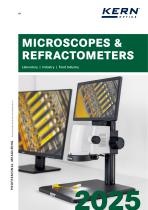
Other KERN & SOHN products
Compound microscopes


Related Searches
- KERN microscope
- KERN optical microscope
- KERN laboratory microscope
- KERN benchtop microscope
- Viewer software
- Windows medical software
- Laboratory software
- KERN LED microscope
- Acquisition software
- Measurement software
- KERN biology microscope
- KERN optical video microscope
- KERN video microscope
- KERN digital video microscope
- KERN LED video microscope
- KERN digital camera video microscope
- KERN USB video microscope
- Inspection video microscope
- KERN trinocular microscope
- KERN research microscope
*Prices are pre-tax. They exclude delivery charges and customs duties and do not include additional charges for installation or activation options. Prices are indicative only and may vary by country, with changes to the cost of raw materials and exchange rates.
About MedicalExpo
MedicalExpo is a marketplace that offers B2B players a complete experience, from product sourcing to purchase. MedicalExpo is an entity of VirtualExpo Group.
Are you a buyer?
Are you a supplier?