


- Laboratory
- Laboratory infrastructure
- Annealing oven
- Labotemp Systems
Muffle furnace FMU-19annealingcalcinationmelting

Add to favorites
Compare this product
Characteristics
- Function
- sintering, heat treatment, annealing, calcination, melting, analysis
- Applications
- laboratory, for scientific research, for general purposes
- Type
- muffle
- Designed for
- for ceramics, for metal
- Sterilization chamber material
- ceramic fiber
- Configuration
- benchtop
- Number of doors
- 1-door
- Other characteristics
- high-performance
- Temperature range
1,200 °C
(2,192 °F)- Capacity
12 l
(3.17 gal)
Description
Overview
Labotemp Muffle Furnace FMU-19 is an electric laboratory muffle furnace engineered for precise thermal processing, materials testing and analytical heating in research, university and industrial quality-control labs. The unit features a 12 L ceramic-fiber chamber, SX3 programmable micro-computer controller (±1°C accuracy, 1°C resolution), high-precision K-type sensor, and an operational range of 100°C to 1200°C, suitable for ashing, sintering, heat treatment and sample preparation for elemental analysis.
Key benefits
Features
Applications
Optional accessories
Specifications
Labotemp Muffle Furnace FMU-19 is an electric laboratory muffle furnace engineered for precise thermal processing, materials testing and analytical heating in research, university and industrial quality-control labs. The unit features a 12 L ceramic-fiber chamber, SX3 programmable micro-computer controller (±1°C accuracy, 1°C resolution), high-precision K-type sensor, and an operational range of 100°C to 1200°C, suitable for ashing, sintering, heat treatment and sample preparation for elemental analysis.
Key benefits
- High-temperature capability up to 1200°C for sintering, calcination and advanced materials tests.
- Accurate temperature management via SX3 microprocessor controller and K-type sensor (±1°C, 1°C resolution).
- Improved thermal efficiency from ceramic-fiber insulation and double-layer construction to reduce heat loss.
Features
- Three-side alloy-wire heating (left, right, top) for uniform temperature distribution.
- Ceramic-fiber chamber providing high insulation and energy efficiency.
- SX3 microprocessor temperature controller with dual display (measured & set temperature) and touch-button setting.
- Fast heating system reaching maximum temperature in ≤ 30 minutes.
- High-precision K-type sensor for stable temperature measurement.
- Safety protections: over-temperature alarm, door safety lock and thermocouple protection.
- Electrostatic coated cold-rolled steel exterior for corrosion resistance.
- Optional upgrades: USB interface, air inlet, 5.0-inch color screen, programmable controller with USB data storage.
Applications
- Material heat treatment
Annealing, sintering and thermal processing of metals, ceramics and composites. - Ash content analysis
Determination of ash in food, polymers, rubber and petroleum products. - Chemical & elemental analysis
Sample preparation and thermal decomposition for analytical workflows. - Ceramic and glass testing
Firing ceramics, melting small glass samples and thermal stability tests. - Research & quality control
Controlled high-temperature experiments in universities, research institutes and industrial labs.
Optional accessories
- Air inlet
- USB interface
- 5.0-inch true color display
- Programmable controller with USB data storage
Specifications
- Model: FMU-19
- Capacity: 12 L
- Temperature range: 100°C – 1200°C
- Temperature resolution: 1°C
- Temperature accuracy: ±1°C
- Heating time to max temp.: ≤ 30 minutes
- Heating mode: Alloy wire heating on three sides (left, right, top)
- Net / Gross weight: 62 / 68 kg
- Power supply: AC 220V / 50–60 Hz
- Heating element: Alloy heating wire
- Power rating: 4.5 kW
- Exhaust port: Ø 30 mm (chimney size 80 × 60 mm)
- Temperature control: SX3 programmable controller
- Temperature setting: Touch button setting
- Temperature display: Dual display (measured & set temperature)
- Timer: 0–99 h 59 min (programmable)
- Sensor: High precision K-type sensor
- Chamber material: Ceramic fiber
- Outer body: Cold-rolled steel with electrostatic coating
- Insulation layer: Ceramic fiber insulation
- Inner chamber size: 200 × 300 × 200 mm
- Exterior size: 530 × 785 × 720 mm
- Packing size: 655 × 875 × 865 mm
- Safety protection: Over-temperature alarm, door safety lock, thermocouple protection
Catalogs
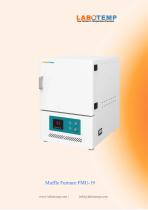
Muffle Furnace FMU-19
5 Pages
Other Labotemp Systems products
Muffle Furnace


Related Searches
- Autoclave
- Steam autoclave
- Laboratory incubator
- Benchtop autoclave
- Automatic autoclave
- Stainless steel autoclave
- Laboratory autoclave
- Temperature-control laboratory incubator
- Heating furnace
- Laboratory furnace
- Laboratory fume extractor
- Climatic test cell
- Benchtop laboratory incubator
- Temperature test cell
- Stainless steel laboratory incubator
- Floor-standing autoclave
- Benchtop furnace
- Front-loading sterilizer
- Humidity test cell
- Autoclave with touchscreen
*Prices are pre-tax. They exclude delivery charges and customs duties and do not include additional charges for installation or activation options. Prices are indicative only and may vary by country, with changes to the cost of raw materials and exchange rates.
About MedicalExpo
MedicalExpo is a marketplace that offers B2B players a complete experience, from product sourcing to purchase. MedicalExpo is an entity of VirtualExpo Group.
Are you a buyer?
Are you a supplier?